
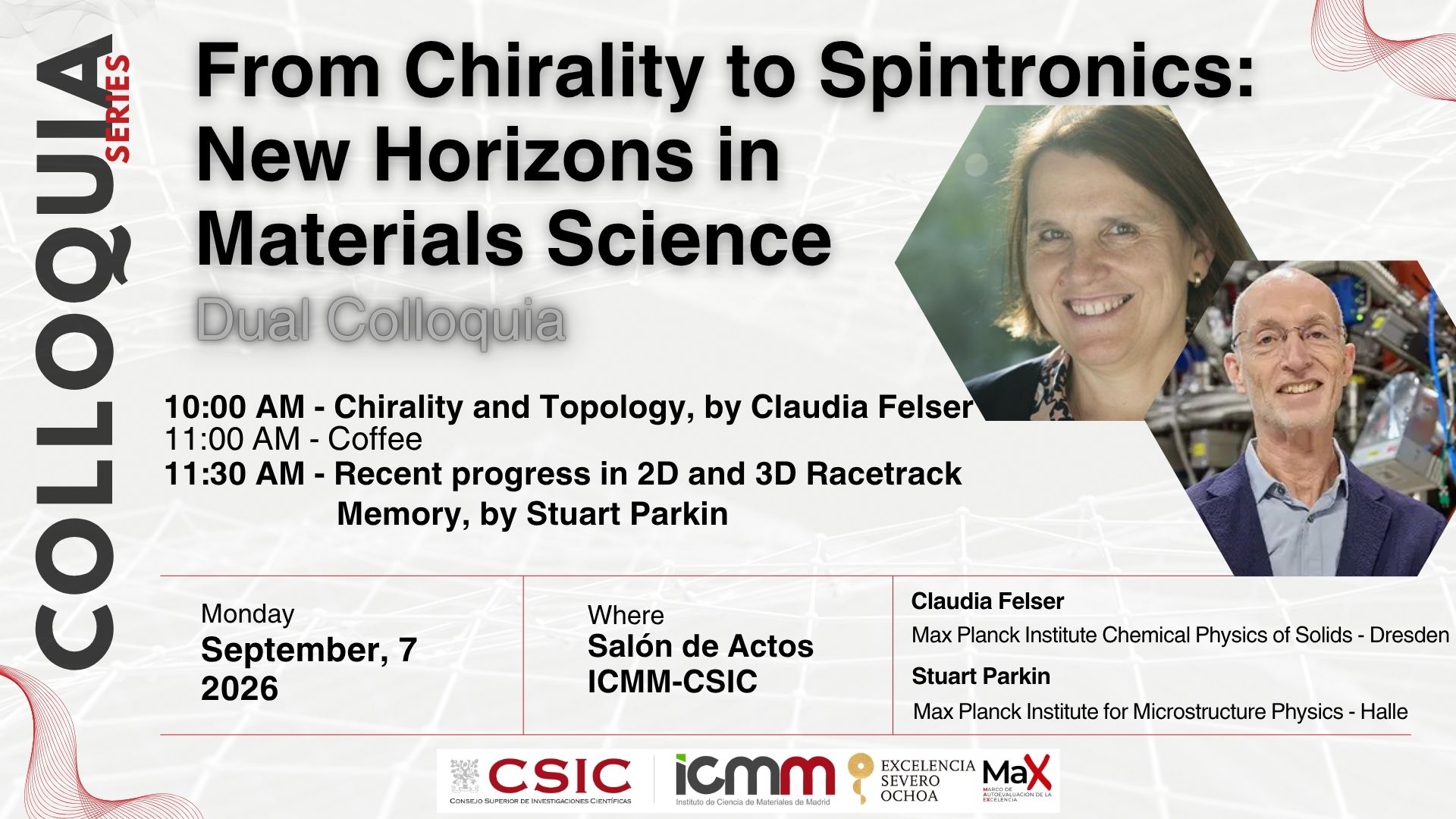
 The Madrid Institute of Material Science is glad to invite you all to this double colloquium on September, 7 at our Main Hall:
at 10 AM:
TITLE: Chirality and Topology
AUTHOR: Claudia Felser, Max Max Planck Institute for Chemical Physics of Solids, Dresden (Germany)
ABSTRACT: Chirality is a very active field of research in inorganic and organic chemistry, closely linked to the concept of structural symmetry and of high importance for catalysis of pharmaceutical molecules. Topology, a well-established concept in mathematics, has nowadays become essential to describe most condensed matter systems. At its core are chiral electron states on the bulk, surfaces and edges of the condensed matter systems, in which spin and momentum of the electrons are locked parallel or anti-parallel to each other. Magnetic and non-magnetic Weyl semimetals, for example, exhibit chiral bulk states that have enabled the realization of predictions from high energy and astrophysics involving the chiral quantum number, such as the chiral anomaly, the mixed axial-gravitational anomaly and axions. The chiral anomaly experimentally realized in Weyl semimetals is one potential explanation for the asymmetry of matter and anti-matter. Chiral topological crystals, combing topology with chirality [9], exist in two chiral forms, exhibit distinguished chiral surface states Chern numbers, different orbital angular momentum for the enantiomers, and distinguished Weyl points, multifold Fermions with different energies. All these properties can eventually be advantageous in asymmetric catalysis. Chiral topological crystals are an opportunity to bridge and study the two worlds, homochirality of molecules and crystals and chirality of particles such as electrons and phonons. The potential for connecting chirality as a quantum number to other chiral phenomena across different areas of science, including the asymmetry of matter and antimatter and the homochirality of life, brings topological materials to the fore.
At 11:00 AM: Coffee break
at 11:30 AM:
TITLE: Recent progress in 2D and 3D Racetrack Memory
AUTHOR: Stuart Parkin, Max Planck Institute of Microstructure Physics, Halle (Germany)
ABSTRACT: Spintronic devices generate and manipulate spin-polarized currents of electrons in atomically engineered heterostructures that allow for novel physical phenomena that make possible spin-valves and magnetic tunnel junction devices. These devices have already had major impact in memory-storage applications in the form of highly sensitive magnetic field sensors that allowed for massive increases in the storage capacity of magnetic disk drives, and, more recently, in the form of a high performance non-volatile magnetic random access memory (MRAM). Beyond these established devices, magnetic racetrack memory has great potential as a highly capacious, solid state, non-volatile memory-storage device that could even replace magnetic hard disk drives1. Racetrack memory stores data in the form of chiral magnetic domain walls that are moved by current-induced spin-transfer and spin-obit torques along magnetic nano-wires that form the racetracks. Recently, it has been demonstrated that racetracks can be reduced to nanoscopic dimensions that are needed for real world applications2. To date, most work on racetrack memory has relied on 2D forms of racetrack. Even more interesting forms of racetrack memory are based on 3D structures, as originally foreseen1. Here we discuss several forms of 3D racetrack memory. First, we discuss the fabrication of ultrathin membranes formed from the racetrack thin film structure that are disposed on surfaces with pre-patterned vertical structures3,4. Secondly, we discuss 3D racetrack devices that are printed via a multi-photon super-resolution microscope that we developed5. This instrument has a voxel size of just 50 nm with which we can create scaffolds formed from an insulating polymeric material on which we use sputtering techniques to deposit the racetrack structures. These 3D racetracks can be printed in various geometrical forms, including racetracks that have twists, both right-handed or left-handed, and racetracks with curvatures along and across the racetracks. We show that these geometries give rise to novel exchange interactions that strongly influence the current induced motion of chiral domain walls in the 3D racetracks.
BOTH AUTHORS ARE INVITED BY: Manuel Vázquez & Oksana Fesenko

