
TITLE: Intrinsic-mesoporous Zeolites-a new frontier in zeolite science and technology
AUTHOR: Professor Peng (Jacky) Lu, Qingdao Institute of Bioenergy and Bioprocess Technology
INVITED BY: Miguel Camblor, ICMM-CSIC
WHEN: July, 7 - 12PM
WHERE: Salón de Actos, ICMM
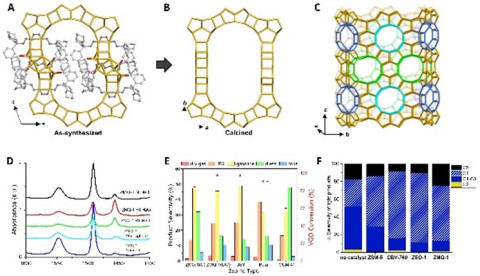
ABSTRACT: The sole presence of micropores impedes the use of zeolites in areas dealing with bulky substrates. Introducing extrinsic mesopores in zeolites is a solution to overcome the diffusion barrier[1-2]. Still, those extrinsic mesopores are generally disordered and non-uniform; moreover, acidity and crystallinity are always, to some extent, impaired[3]. Here, we report ZMQ-1, an aluminosilicate zeolite with an intersecting intrinsic meso-microporous channel system delimited by 28×10×10-rings, where the 28-ring has a free diameter of 22.76 Å×11.83 Å, which reaches the mesopore domain (Figure 1A-C)[4]. A bolaform phosphonium-based OSDA was used for ZMQ-1 synthesis, whose position was determined from 3D ED data: the positively charged bulky and rigid heads direct the formation of the large pore space, whereas the long distance between the charged heads leaves enough space for the formation of zeolite framework (Figure 1A). This provides an incentive for preparing other stable mesopore-containing zeolites. ZMQ-1 possesses high thermal and hydrothermal stability, with tunable framework Si to Al molar ratios. We demonstrate that vacuum calcination or targeted post-synthetic washing (NH4Cl) removes ~90% of residual phosphorus species, which otherwise severely diminishes Brønsted acid sites density and accessibility. The Brønsted acidity of ZMQ-1 imparts high activity and unique selectivity in the catalytic cracking of heavy oil (Fig.1E). Notably, phosphorus-containing ZMQ-1 shows higher selectivity towards fuels (gasoline+diesel) up to 80%, accompanied by a lower percentage of coke formation. In catalytic cracking of plastics (Fig.1F), ZMQ-1 shows lowest coke formation, higher yield towards branched saturated hydrocarbons. These findings establish ZMQ-1 as a landmark catalyst bridging the gap between zeolitic acidity and mesoporous accessibility.
References:
[1] Choi, M. et al, Nature 461, 246-249 (2009).
[2] Han, S. et al., Angew. Chem. Int. Ed. 61, e202210434 (2022).
[3] Serrano, D. P., Escola, J. M. & Pizarro, P., Chem. Soc. Rev. 42, 4004-4035 (2013).
[4] Lu, P. et al, Nature 636, 368-373 (2024).

