
Researchers manage to create and trap a high-valent Nickel (IV) species, a key step for new energy technologies
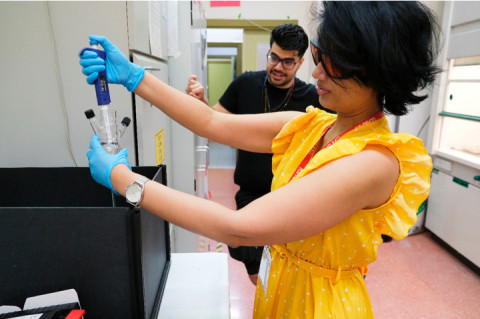
The Madrid Institute of Material Sciences (ICMM-CSIC) participates and leads international team of researchers that has just manage to control a high-valent Nickel(IV) species, being able to create and trap it. This work transforms nickel (IV) from a controversial or speculative concept into a well-defined chemical reality and has been published at JACS Au.
Dooshaye Moonshiram, a researcher at the ICMM-CSIC and one of the leaders of the work, explains that nickel is one of the most abundant transition metals on Earth and “it is already central to modern chemistry, from industrial catalysis to energy technologies”. However, the researcher says that its most powerful chemical behaviour “emerges only when it reaches very high oxidation states, particularly nickel(IV), a short lived ‘high energy’ form capable of driving reactions that lower valent nickel simply cannot”.
Here is the key of the work on nickel: These highly oxidizing species and their reactions underpin the manufacture of pharmaceuticals, fine chemicals, and advanced materials. Importantly, nickel offers a sustainable alternative to precious metals such as palladium or platinum, making a fundamental understanding of Ni(IV) chemistry essential for greener catalysis.
Until now, the intrinsic instability of nickel has made them extraordinarily difficult to observe directly, bus this international group of researchers has manage a new way to do that by using some ligands –a kind of molecule that binds to a central metal atom or ion to form a coordination complex—that enables to distinguish the nickel(IV) from the nickel (III).
But this nickel(IV) is not merely detectable: “It is reactive in a controlled way,” says the researcher. She adds that this breakthrough was made possible using advanced X ray absorption spectroscopy at the Stanford Synchrotron Radiation Lightsource (SSRL): “To capture the extremely short lived Ni(IV) intermediate, specially designed PEEK sample cells were developed, allowing rapid freezing of the reactive species before it decomposed. This freezing step effectively “paused” the chemistry, enabling atomic level analysis.”
By definitively identifying how nickel(IV) forms, what it looks like, and how it reacts, this work transforms Ni(IV) from a controversial or speculative concept into a well-defined chemical reality. “It provides a reference point for future studies of high valent nickel chemistry, informs the design of more efficient and sustainable catalysts, and deepens our understanding of how nature harnesses high energy metal states to perform life-sustaining chemistry,” concludes the researcher.
Reference:
Ayushi Awasthi, Kiran Bhadauriya, Lucia Velasco, Raju Eerlapally, Asterios Charisiadis, Rakesh Kumar, Maxime Sauvan, Dooshaye Moonshiram*, Sharath Chandra Mallojjala*, and Apparao Draksharapu*. Spectroscopically Deciphering the Formation and Reactivity of a High-Valent Ni(IV)Cl2 Species. JACS Au. DOI: 10.1021/jacsau.5c01182
ICMM
Sor Juana Ines de la Cruz, 3
Cantoblanco, 28049
Madrid, España
Teléfono: (+34) 91 334 90 00
Email: @email
Oficina de Comunicación/Prensa: @email

Acknowledge the Severo Ochoa Centres of Excellence program through Grant CEX2024-001445-S/ financiado por MICIU/AEI / 10.13039/501100011033

Contacto | Accesibilidad | Aviso legal | Política de Cookies | Protección de datos