
The CSIC installs a new electron microscope in Madrid that enables higher resolution and real-time chemical analysis
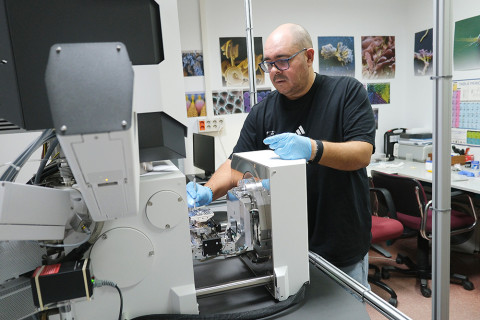
The Spanish National Research Council (CSIC)—an entity under the Ministry of Science, Innovation and Universities (MICIU)—has just installed a new field-emission scanning electron microscope (FE-SEM) at the Cantoblanco Campus in Madrid, the only one of its kind in the area. Housed at the Madrid Institute of Materials Science (ICMM-CSIC), it is affiliated with the Institute of Ceramics and Glass (ICV-CSIC) and the Institute of Catalysis and Petrochemistry (ICP-CSIC). The instrument is available for use by the broader research community.
The Apreo 2 ChemiSEM microscope has been funded by the European Union – NextGenerationEU, through the Recovery and Resilience Facility within the national framework: the Recovery, Transformation and Resilience Plan (PRTR) of the Government of Spain (Scientific Project Code: MICRO24004).
This will expand the CSIC’s capabilities in the field of electron microscopy. “Although there are other electron microscopes on campus, this one stands out because it can simultaneously address analytical and resolution-related challenges—tasks that other instruments in the area must perform separately,” explains Bernd Wicklein, a CSIC researcher at the Institute of Materials Science of Madrid and the scientist in charge of the facility.
In this way, this microscope stands out within the Community of Madrid due to the simultaneous combination of four key factors: on one hand, it enables integrated quantitative X-ray microanalysis, which allows for real-time quantitative elemental mapping while navigating the sample, as well as the detection of light elements without the need for additional, time-consuming data acquisition steps.
Furthermore, the microscope allows for the analysis of magnetic samples with nanometric resolution (that is, one millionth of a millimeter) without the magnetism distorting the lens system. “This is a common limitation in traditional magnetic-immersion microscopes,” continues Wicklein, explaining that the vast majority of ultra-high-resolution microscopes use magnetic-immersion objective lenses, which either prevent the observation of ferromagnetic or strongly magnetic materials or cause distortions during such observation.
Furthermore, the Apreo 2 incorporates two automation algorithms for beam alignment and adjustment, which helps minimize turnaround times and enables intensive use of the system.
The FE-SEM team—comprising staff from three CSIC centers—also highlights one final advantage of this instrument: it includes an arm for inserting samples into a vacuum environment, ensuring they are not exposed to potentially damaging atmospheres.
With the installation of this microscope, the CSIC continues to strengthen its capabilities in these techniques and its position of leadership in the field. The services provided by this FE-SEM are part of the Scientific-Technical Services Unit (USCT) at the ICMM-CSIC; inquiries can be directed to the email address @email.
Instituto de Ciencia de Materiales de Madrid (ICMM)
Sor Juana Ines de la Cruz, 3
Cantoblanco, 28049
Madrid, España
Telephone: (+34) 91 334 90 00
Email: @email
Communication Office: @email

Acknowledge the Severo Ochoa Centres of Excellence program through Grant CEX2024-001445-S/ financiado por MICIU/AEI / 10.13039/501100011033

Contacto | Accesibilidad | Aviso legal | Política de Cookies | Protección de datos