
Ángela Matarín is defending her thesis: "Research requires a lot of patience, as things do not always work the first time"
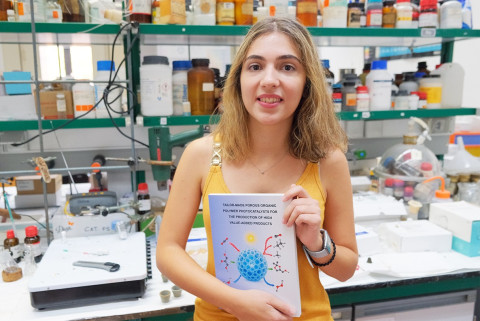
The career journey of Ángela Matarín Serrano has reached an important milestone: she will be defending her thesis on 21st September at the ICMM. Her research, supervised by ICMM researchers Eva Maya and Marta Iglesias, is entitled Tailor-made porous organic polymer photocatalysts for the production of high value-added products. This thesis focuses on the synthesis and characterization of several porous organic polymers (POPs), which have been employed as photocatalysts in a variety of reactions, including CO₂ reduction, glycerol acetalization, and H₂O₂ production. Having finished this work, Ángela shares her insights and feelings.
Why did you choose ICMM for your PhD?
I already knew ICMM before starting my PhD because I had completed both my degree internship and my master's thesis here. From the beginning, I felt very comfortable with the group and the people at the institute. Moreover, the possibility of working in such a multidisciplinary centre strongly motivated me to begin my PhD at ICMM.
How would you explain your research to a non-scientific audience?
My research focuses on the synthesis of porous organic materials that act as photocatalysts. This means that they can be irradiated with light, ideally sunlight, to drive different chemical reactions. These reactions transform harmful or abundant molecules into valuable products in a more sustainable way.
What are the main applications of your research? Could you give us an example?
The main application of my research is the production of high value-added products through photocatalysis. For example, we can transform CO₂ into valuable chemicals for industrial applications or produce hydrogen peroxide from water.
What are the lessons you had learnt here? which one do you value the most?
During these years, I have learned a lot at an academic level, from using new techniques to interpreting scientific results. However, my day-to-day experience has also taught me many valuable lessons. One of them is the importance of teamwork, as discussing ideas with other people often leads to better solutions and new perspectives. But probably the most important lesson I have learned here is that research requires a lot of patience, as things do not always work the first time.
How do you think this experience will contribute to your training and to your future?
This experience has been essential for my development as a researcher. It has allowed me to gain scientific knowledge and technical skills, while becoming more self-sufficient when solving problems. It has also taught me how to work effectively in a team, collaborate with researchers from different backgrounds, and face new challenges. I am sure that these skills will be essential in my future career.
What are your plans once you finish your PhD?
After finishing my PhD, I would like to continue developing my research career, either in academia or in industry. I am open to new opportunities and challenges, and I am excited to keep learning and contributing through my work.
Why did you become a scientist?
Becoming a scientist was not something I had planned when I was a child. However, when I discovered chemistry, I realized it was the path I wanted to follow. The opportunity to do research, discover new things, and contribute to society is what motivated me to pursue a career in science and continue growing as a researcher.
Instituto de Ciencia de Materiales de Madrid (ICMM)
Sor Juana Ines de la Cruz, 3
Cantoblanco, 28049
Madrid, España
Telephone: (+34) 91 334 90 00
Email: @email
Communication Office: @email

Acknowledge the Severo Ochoa Centres of Excellence program through Grant CEX2024-001445-S/ financiado por MICIU/AEI / 10.13039/501100011033

Contacto | Accesibilidad | Aviso legal | Política de Cookies | Protección de datos