
Najmeh Eshaqi, new postdoctoral researcher at the Photonic Crystals group
Najmeh Eshaqi Sani comes from Iran and joined the ICMM last January. She is a postdoctoral Marie Skłodowska-Curie Actions (MSCA) researcher who became a member of the Photonic Crystals group, led by Ceferino Lopez at ICMM. She has chosen the ICMM to pursuit her career because of her interest in combining both theoretical and experimental approaches: "As a theoretician, the opportunity to work in close collaboration with experimental groups at ICMM is exciting for me", expresses.
Where do you come from?
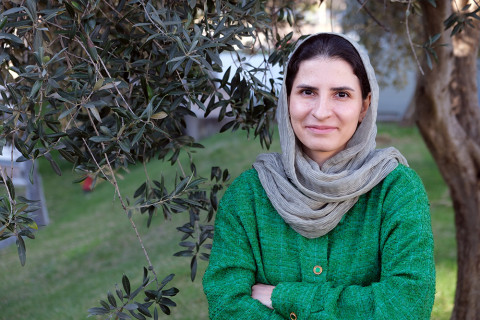
My academic journey has been significantly started by my studies at my hometown university, Ferdowsi University of Mashhad, Iran, and the excellent courses that I took there and then it continued and was developed by training and doing research at the group o Rosario Fazio at the Abdus Salam International Centre for Theoretical Physics (ICTP), a leading international institute in Trieste, Italy, and the group of quantum opto-mechanics led by David Vitali at University of Camerino, Italy. In addition, I have collaborated with the research groups at the Institute for Research in Fundamental Sciences (IPM), University of Parma, and one of my colleagues who works as an associate professor in China.
What have you worked on so far?
A central theme of my research is the exploration of driven-dissipative phenomena in coupled-mode systems such as optical and opto-mechanical systems, and how to harness them for information processing and quantum technologies. My research experience spans both theoretical and practical aspects of these systems. During my PhD, I focused on topics related to superconducting circuit/cavity QED, quantum synchronization, entanglement, and quantum control of opto/electro-mechanical systems. Then I worked on nonreciprocal transport, quantum engineering in order to suppress quantum noise, enhanced sensing in opto-mechanical systems, and quantum control techniques.
What will you work on? With whom?
Recently, I have been interested in exploring suitable platforms to build optics-based neuromorphic learning machines. In line with this direction, in my project at ICMM-CSIC in Madrid and subsequently at INMA-CSIC in Zaragoza, I will work on opto-mechanical and photonic platforms for more efficient neuromorphic computing. I will collaborate with Prof. Ceferino Lopez and Dr. David Garcia at ICMM-CSIC and with Luis Martin Moreno at INMA-CSIC.
Why did you choose ICMM?
I chose ICMM because its research direction aligns with my recent interests, combining both theoretical and experimental approaches. As a theoretician, the opportunity to work in close collaboration with experimental groups at ICMM is exciting for me.
And a personal touch: any hobbies?
I love nature and find peace in its various beauties. I enjoy hiking, spending time outdoors, reading, poetry in my mother tongue (Persian), music, traveling, and spending time with my family and friends.
What would you like to contribute to the institute?
I would like to participate in projects dedicated to student education and training. I am especially keen on programs like Physics Without Frontiers, which bring physics training to underserved communities, and I would be happy to contribute to organizing such programs.
ICMM
Sor Juana Ines de la Cruz, 3
Cantoblanco, 28049
Madrid, España
Teléfono: (+34) 91 334 90 00
Email: @email
Oficina de Comunicación/Prensa: @email

Acknowledge the Severo Ochoa Centres of Excellence program through Grant CEX2024-001445-S/ financiado por MICIU/AEI / 10.13039/501100011033

Contacto | Accesibilidad | Aviso legal | Política de Cookies | Protección de datos