
Our serie of Scientific Seminars continues with the next talk:
Title: Orbitronics: moving beyond spin
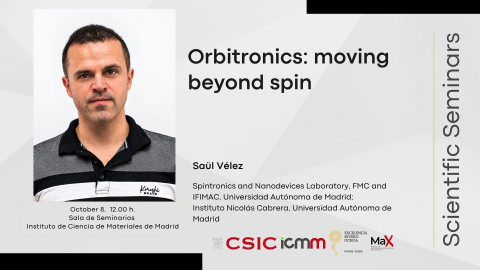
Author: Saül Vélez, Spintronics and Nanodevices Laboratory, FMC and IFIMAC, Universidad Autónoma de Madrid; Instituto Nicolás Cabrera, Universidad Autónoma de Madrid.
Where: Sala de Seminarios, ICMM-CSIC
When: 8th October, 12h
Abstract: Orbitronics seeks to exploit the orbital degree of freedom of electrons as a carrier of angular momentum, complementing spin in modern electronics. In this seminar, I will introduce the basic concepts of orbitronics and discuss experiments illustrating how orbital angular momentum can be generated, detected and harnessed to control magnetic order at the nanoscale. I will discuss two complementary approaches to generate and detect orbital angular momentum. First, by combining spectroscopic x-ray techniques and spin-orbit torques, we directly probe current-induced orbital accumulation at Cu/oxide interfaces and quantify charge-to-orbit conversion figures of merit, finding that Cu/CuOₓ is the most energy-efficient angular momentum generator reported to date at room temperature, outperforming heavy metals, two-dimensional electron gases and topological insulators [1]. I will then show how surface acoustic waves and chiral phonons can generate orbital currents in Ni/Ti and Ni/Cr, with their symmetry enabling the separation of acoustic pumping and the acoustic orbital Hall effect and revealing angular-momentum transfer between lattice motion and conduction electrons [2]. I will conclude by discussing orbital-to-spin conversion, orbital torques and the opportunities offered by light materials and interfaces for orbitronic devices.
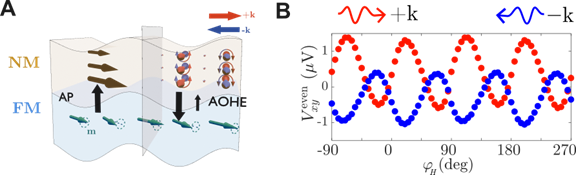
Fig. 1 | Acoustic generation of orbital currents. A, Schematic of acoustic pumping (AP) and the acoustic orbital Hall effect (AOHE). B, AOHE voltage for opposite SAW propagation directions.
[1] P. Pradeep et al., submitted.
[2] M. Rovirola et al, Chiral-phonon generation of orbital currents in light transition metals, arxiv:2512.08385 (2025).

