
Universal law determined to predict the characteristics of magnetic materials
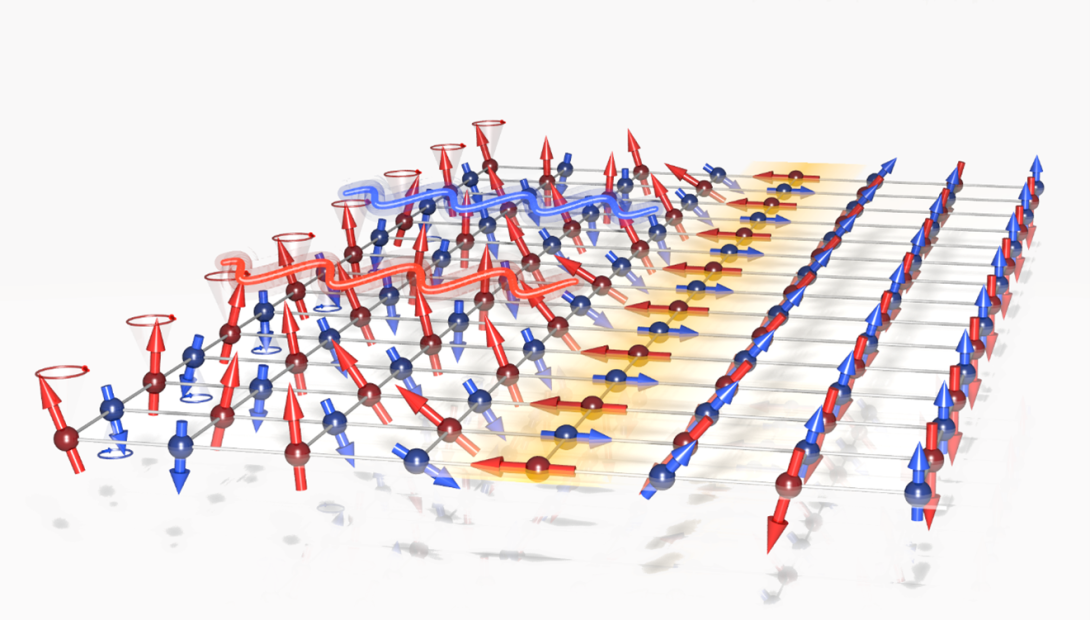
A research team from the Institute of Materials Science of Madrid, an entity dependent on the Spanish National Research Council, has found an "unexpected connection" between two magnetic phenomena that until now had been described separately. This relationship between them has allowed them to define a new universal law to predict the size of certain magnetic characteristics of materials, which will be key to the advancement of spintronics or magnetic storage devices.
The results of the work, which has just been published in Physical Review Letters, are also applicable to a wide variety of magnetic materials. Unai Atxitia, a researcher at ICMM-CSIC and lead author of the work, explains that there are two fundamental magnetic phenomena that, until now, had been described separately: spin waves and domain walls.
"Spin waves are magnetic perturbations that travel through a material, while domain walls are static boundaries that separate regions with different magnetic orientation," describes the scientist. That is, every magnetic material is divided into zones (called 'magnetic domains') where all atomic spins point in the same direction, and the point where they change direction – where we go from one zone to another – would be the domain wall.
By demonstrating that both characteristics are, in essence, two manifestations of the same phenomenon (one dynamic and one static), this team has developed "a universal description that allows predicting the size of these walls in a wide variety of magnetic materials from their fundamental properties," adds José M. Lendínez, a predoctoral researcher at ICMM-CSIC and first author of the study.
In this way, by calculating how the magnetic excitations of the material (the spin) propagate, the size of the domain walls can be predicted: "Our approach constitutes a powerful tool for understanding the profiles of domain walls in complex spin systems," says Marta Yanguas, also a predoctoral researcher at ICMM-CSIC and part of the work team along with Theodor Griepe and Michael Saur.
The importance of the work is capital, since domain walls are a key element in emerging technologies such as magnetic memories or spintronics, a new technology that promises to revolutionize the development of microelectronic devices. This is because the width of that wall directly affects the energy needed to move it, its stability and, therefore, the operating speed of future devices. In this way, knowing its size will allow complex magnetic materials to be designed much more efficiently.
The team has verified its predictions through large-scale atomistic spin dynamics simulations, and the results have been positive. "Our approach constitutes a powerful tool for understanding the profiles of domain walls in complex spin systems," concludes Atxitia.
Reference:
José M. Lendínez, Marta Yanguas, Theodor Griepe, Michael Saur, Rubén M. Otxoa, Levente Rózsa, and Unai Atxitia, Generalized theory of domain-wall width in multisublattice Heisenberg magnets, Physical Review Letters. DOI: https://doi.org/10.1103/7jsh-bbdb
Instituto de Ciencia de Materiales de Madrid (ICMM)
Sor Juana Ines de la Cruz, 3
Cantoblanco, 28049
Madrid, España
Telephone: (+34) 91 334 90 00
Email: @email
Communication Office: @email

Acknowledge the Severo Ochoa Centres of Excellence program through Grant CEX2024-001445-S/ financiado por MICIU/AEI / 10.13039/501100011033

Contacto | Accesibilidad | Aviso legal | Política de Cookies | Protección de datos