
Researchers create solar panels that also generate electricity from raindrops
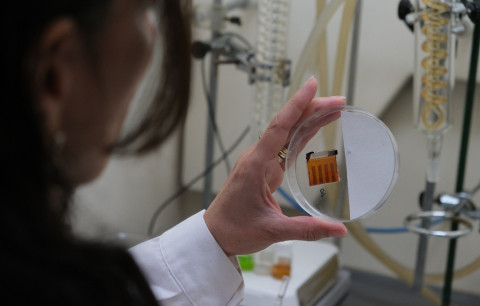
The Madrid Institute of Materials Science (ICMM-CSIC) has succeeded in developing a hybrid device capable of generating energy both from sunlight and from the impact of raindrops. The work has just been published in the journal Advanced Functional Materials.
The ICMM team has worked on a type of material called Covalent Organic Frameworks (COFs), a nanometric polymer – with a size on the order of one millionth of a millimeter – composed of organic molecules and having a crystalline (that means, ordered) and porous (with voids) structure. These are very promising materials because they are easily designable and versatile, so they can be used in a wide variety of applications.
Eva María García Frutos, a researcher at ICMM-CSIC and one of the lead authors of the study, explains that they chose a type of COF known for its high stability, uniform pores, and applications in photocatalysis (the so-called COF TpPa1), and that they fabricated it on a hybrid device that combined an organic solar cell with a triboelectric generator (which generates electricity from motion). "By incorporating a triboelectric nanogenerator layer, we were able to generate additional energy from the mechanical impact of raindrops," the scientist describes.
Thanks to this combination, they obtained an extremely thin, highly homogeneous film of nanometric thickness, which was also fabricated on a polylactic acid (PLA) layer, a biodegradable and environmentally friendly material, "unlike the fluorinated polymer films commonly used," the researcher continues.
In this way, "we demonstrated that the hydrophobic PLA film produces electricity under prolonged water dripping, resists degradation, and its high optical transparency ensures minimal impact on the operation of the underlying solar cell," García Frutos's team celebrates.
The main conclusion of this preliminary study is that the device "demonstrated its ability to produce energy on both sunny and rainy days." Likewise, the team demonstrated the stability of the organic solar cells, since their activity barely decreased after several months.
Now, the team is preparing additional studies to optimize the performance of their photovoltaic panel with other COF materials. "The resulting multi-harvester systems could help improve the sustainability of future organic solar cells and constitute a promising alternative in the development of hybrid nanoenergy devices," the researcher concludes.
Reference:
Joab D. Guerrero, Susana Ramos-Terrón, Salvador R. G. Balestra, José M. Malagón, David Aparicio, Lucia Velasco, Asterios Charisiadis, Dooshaye Moonshiram, Margarita Darder, Pilar Aranda, Bernd Wicklein, Gustavo de Miguel, Javier Pérez-Carvajal*, Eva M. García-Frutos*. Hybrid Solar Cell/Triboelectric Nanogenerator Based on Stable Two-Dimensional Covalent Organic Frameworks. Advanced Functional Materials. DOI: https://doi.org/10.1002/adfm.76340
Instituto de Ciencia de Materiales de Madrid (ICMM)
Sor Juana Ines de la Cruz, 3
Cantoblanco, 28049
Madrid, España
Telephone: (+34) 91 334 90 00
Email: @email
Communication Office: @email

Acknowledge the Severo Ochoa Centres of Excellence program through Grant CEX2024-001445-S/ financiado por MICIU/AEI / 10.13039/501100011033

Contacto | Accesibilidad | Aviso legal | Política de Cookies | Protección de datos