
New technique shields satellites from 'multipactor effect' that causes irreparable space damage
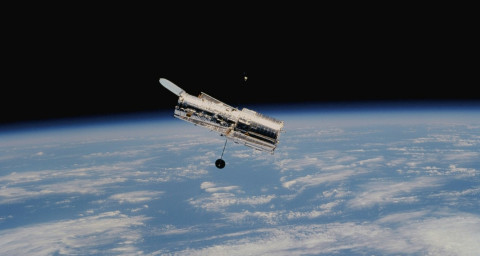
The Madrid Institute of Materials Science (ICMM-CSIC), part of the Spanish National Research Council, in collaboration with the CSIC spin-off Nanostine, has developed a coating for satellite components that protects them from the dreaded 'multipactor effect'—a dangerous avalanche-like electron discharge that occurs in radiofrequency and microwave components when they are in a vacuum, such as in space, and which causes catastrophic and irreparable damage to devices like communications antennas. The results obtained with the new coating, developed in collaboration with the European Space Agency (ESA), have been published in the journal Applied Surface Science, one of the most relevant in the sector, and have been protected by a patent.
The ESA has spent over four decades searching for solutions to reduce the risk associated with the multipactor effect, although there is still a need to develop treatments with better performance, since an optimal coating has not yet been achieved: "Most of the protective coatings on these current satellite components are made with Alodine, but it is harmful to health and the environment, so there is a desire to ban it, but we need an alternative, and those that have emerged so far do not offer the performance required by the aerospace sector," explains Lidia Martínez, a researcher at the Madrid Institute of Materials Science and one of the authors of the work.
This team proposes a solution based on both the composition and the surface structure of the coating: instead of working at the microscale, like most of the proposed alternatives, they have modified the surface roughness at the nanometric level (on a scale of one millionth of a meter), and they have done so with a gold and silver coating based on nanoparticles manufactured using ultra-high vacuum equipment. In this way, they have obtained nanostructured metallic coatings that are not only capable of replacing Alodine but also offer better performance.
The ESA required a material that had several critical characteristics: on the one hand, a low secondary electron emission yield (the origin of the multipactor effect); they need the coating to emit few secondary electrons (those that 'bounce back' when an electron strikes the material), and this coating manufactured at the ICMM reduces this emission by 30% compared to Alodine.
Furthermore, another key point is what is called the cut-off energy: "this is the value of the energy of the electrons striking the surface above which you begin to produce more electrons than arrive," explains Martínez. On this point, the ICMM's formula is 300% more efficient than current ones. "We not only address the current problem, but we improve upon what exists now," the researcher celebrates.
Technology Transfer
The coating is manufactured using ultra-high vacuum technologies, which means it is relatively easy to implement on an industrial scale. In fact, the entire process has been developed in collaboration with the CSIC spin-off Nanostine and thanks to an Industrial Doctorate program of the Community of Madrid carried out by researcher César Rodríguez-Castañeda.
Likewise, the ESA itself has participated through the ESA Business Innovation Center, coordinated in Madrid by the Madri+d Foundation. This has made it possible to work hand-in-hand with the Agency's needs. "All our validation tests have been carried out in ESA-certified laboratories," explains the researcher.
The patent for the coating has already been filed jointly by the CSIC and Nanostine, and a licensing agreement has been closed for Nanostine to commercialize these coatings, focused primarily on the aerospace sector. Even so, many steps lie ahead: "the research to take a coating into space takes about a decade; you have to take every single step. Right now, our results are very promising, and the ESA has expressed its satisfaction with our real solution, but we must continue working," concludes the researcher.
Instituto de Ciencia de Materiales de Madrid (ICMM)
Sor Juana Ines de la Cruz, 3
Cantoblanco, 28049
Madrid, España
Telephone: (+34) 91 334 90 00
Email: @email
Communication Office: @email

Acknowledge the Severo Ochoa Centres of Excellence program through Grant CEX2024-001445-S/ financiado por MICIU/AEI / 10.13039/501100011033

Contacto | Accesibilidad | Aviso legal | Política de Cookies | Protección de datos