
Eloy Pablo Gómez de Oliveira, new postdoctoral researcher in the SUPREMA group
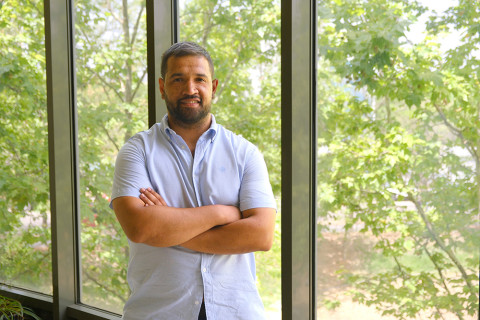
Our new postdoctoral researcher in the Supramolecular, Polymeric, and Reticular Materials (SUPREMA) group is Eloy Pablo Gómez de Oliveira, a Madrilenian who earned his bachelor’s degree in Chemistry from the University of Alcalá, his master’s degree in Chemical Science and Technology (specializing in Inorganic Chemistry) from the UNED while working here at the Madrid Institute of Material Sciences (ICMM-CSIC) as a pre-doctoral researcher, and jus completed his thesis at the Institute of Molecular Science at the University of Valencia (ICMol-UV) this year.
What have you worked on so far?
So far, my research has focused on the design, synthesis, and characterization of MOF-type hybrid materials, as well as their post-synthesis modification to obtain new materials or improve their properties for specific applications.
What will you work on? With whom?
I will be working with Celia Castillo Blas and Felipe Gándara Barragán on the design, synthesis, and modification of a specific type of MOF—Zeolitic Imidazolate Frameworks (ZIFs)—which possess certain characteristics and qualities that make them interesting for applications that are unconventional for these materials.
Why did you choose ICMM?
I believe it’s a leading research center, with top-tier professionals in their respective fields, where I can grow as a professional through a multidisciplinary approach. Specifically, I chose this group because I’ve already worked with them and continued to collaborate during my thesis, and I believe my background can contribute to the group as we pursue top-quality science.
And a personal touch: any hobbies?
I really enjoy reading, watching TV shows, going on motorcycle rides, and contact sports (I currently box).
What would you like to contribute to the institute?
I think I could lead a seminar on some characterization topics, or even a course on the techniques I’ve worked with most, such as diffraction—including data processing for single crystals or refinements of powder diffractograms—gas adsorption and porosity analysis, or microscopy (more specifically, scanning electron microscopy).
Instituto de Ciencia de Materiales de Madrid (ICMM)
Sor Juana Ines de la Cruz, 3
Cantoblanco, 28049
Madrid, España
Telephone: (+34) 91 334 90 00
Email: @email
Communication Office: @email

Acknowledge the Severo Ochoa Centres of Excellence program through Grant CEX2024-001445-S/ financiado por MICIU/AEI / 10.13039/501100011033

Contacto | Accesibilidad | Aviso legal | Política de Cookies | Protección de datos