
David Fernández is defending his thesis: "I enjoy the mix of creativity and discipline: you need imagination to propose a model, but rigor to prove it’s right"
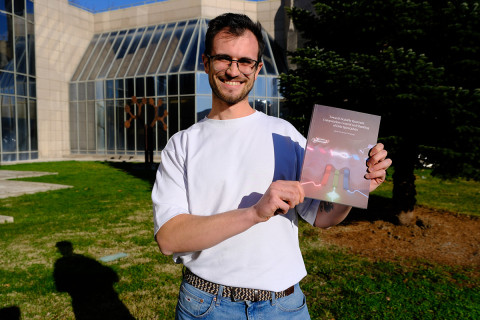
David Fernández is arriving to the end of a long journey: the defense of his doctoral thesis. He will do it next January 28th at our institute. The title of his thesis, supervised by Gloria Platero, is 'Towards Scalable Quantum Computation: Control and Shuttling of Hole Spin Qubits'.
After his defense, he aims to continue with his research: "In the future, this experience will help me lead independent projects, choosing impactful questions, developing robust control/transport strategies, and communicating results in a way that accelerates collaboration and real-world implementation", he says.
Why did you choose ICMM for your PhD?
I chose the ICMM because of its strong reputation in condensed matter physics and materials science, particularly in theoretical and computational research. The institute offers an excellent scientific environment. ICMM also provided the opportunity to work with leading researchers in my field and to be part of an active international community. This combination made it an ideal place to develop my PhD research both scientifically and professionally.
How would you explain your research to a non-scientific audience?
My PhD is about making quantum computers more scalable by improving how we control and move quantum information inside semiconductor chips. In our devices, a qubit is encoded in the spin of a single charge carrier, which you can picture as a tiny compass needle trapped in an small, electrically defined box called a quantum dot. The big challenge is that these fragile quantum states are easily disturbed by electrical noise, and a useful processor also needs a reliable way to connect distant qubits—like moving a delicate message across a crowded room without smudging it.
What I did was develop theoretical models and practical recipes for two things: (1) fast, robust control pulses that manipulate the qubit with high accuracy even in realistic noise, and (2) shuttling protocols that transfer a qubit across many quantum dots while keeping the information intact. A key ingredient is spin–orbit interaction, a built-in property of holes that lets electric signals steer the spin more efficiently, and can even enable performing quantum gates while the qubits are moving, reducing overhead. Overall, the work provides design principles for building quantum-dot chips where qubits can be controlled precisely and connected over longer distances, which is essential for large-scale architectures.
What are the main applications of your research? Could you give us an example?
The main applications are in scalable quantum computing hardware, especially semiconductor spin-qubit chips where you need both high-fidelity control and a way to connect qubits over distances on the same device. My research helps design control and transport protocols that keep quantum information intact despite realistic electrical noise, which is essential for building larger processors.
A concrete example: imagine two qubits stored in different sites of a chip, rather than wiring a separate control line for each interaction, you can move one qubit along a chain of quantum dots and perform a gate when it reaches the other qubit, then move it back, all while maintaining high fidelity. This kind of reliable quantum transport + gate toolbox directly supports architectures with more qubits, fewer bottlenecks, and better error rates.
What are the lessons you had learnt here? Which one do you value the most?
I learned how to turn a complex physical problem into a clear, testable model, and then iterate between theory, numerics, and practical constraints until the result is useful for real devices. I also learned the value of communicating results, writing, presenting, and aligning with collaborators so that the work is understandable and actionable beyond my own desk. Another key lesson was staying rigorous under uncertainty: debugging assumptions, validating approximations, and being honest about limitations.
How do you think this experience will contribute to your training and to your future?
This PhD trained me to take a problem from first principles to practical protocols: build a solid model, derive effective descriptions, validate them numerically, and translate the outcome into clear predictions and design guidelines. That workflow is exactly what I will keep using in my postdoc, where I plan to extend the ideas from my thesis to more complex architectures and new regimes of operation. It also strengthened my ability to work at the interface between theory and experiment, identifying what is measurable, what is tunable, and what matters most for device performance.
In the future, this experience will help me lead independent projects: choosing impactful questions, developing robust control/transport strategies, and communicating results in a way that accelerates collaboration and real-world implementation.
What are your plans once you finish your PhD?
After finishing my PhD, I will start a postdoctoral position where I will extend the ideas developed in my thesis to more advanced and scalable quantum-dot architectures. My goal is to push the theoretical work closer to experimentally relevant conditions, improving robust control, transport, and gate protocols in realistic devices. In parallel, I want to keep building a strong publication record and broaden my collaborations, especially at the interface between theory and experiment.
Why did you become a scientist? Who have been your role models?
I became a scientist because I’ve always been drawn to questions where the rules aren’t obvious at first, where you have to build understanding step by step and then test it against reality. What really hooked me was realizing that abstract ideas in quantum physics can be turned into concrete predictions and even into technologies, like qubits on a chip. I also enjoy the mix of creativity and discipline: you need imagination to propose a model, but rigor to prove it’s right. My main role model is Francis Villatoro, a Spanish mathematician and science communicator known for his deep, wide-ranging understanding and his ability to explain complex concepts with exceptional clarity. I admire how he can discuss almost any topic with remarkable depth, connect ideas across fields, and still make difficult material accessible in a structured way. That precision and communication is the standard I try to aim for in my own work.
ICMM
Sor Juana Ines de la Cruz, 3
Cantoblanco, 28049
Madrid, España
Teléfono: (+34) 91 334 90 00
Email: @email
Oficina de Comunicación/Prensa: @email

Acknowledge the Severo Ochoa Centres of Excellence program through Grant CEX2024-001445-S/ financiado por MICIU/AEI / 10.13039/501100011033

Contacto | Accesibilidad | Aviso legal | Política de Cookies | Protección de datos