
Sumit Haldar joins the Multiscale Materials Modelling Group
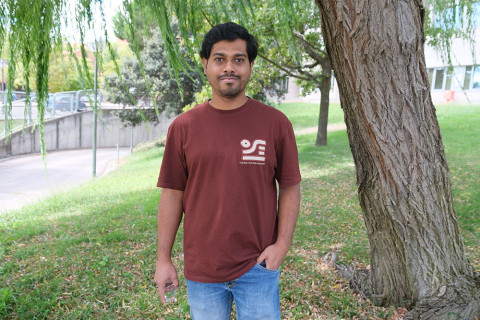
Sumit Haldar is a new member of the Multiscale Materials Modelling Group. Originally from Kolkata, India, he just joined the Madrid Institute of Materials Science (ICMM-CSIC) this year as a postdoctoral research associate through the ALLIES MSCA COFUND Postdoctoral Fellowship, working with Silvia Gallego Queipo.
What have you worked on so far?
During my PhD, I mainly worked on the theoretical modelling of molecular magnetism. Later, I worked on identifying phase transitions in both classical and quantum systems using machine learning. In my previous postdoctoral position, I focused mainly on ultrafast magnetization dynamics in two-dimensional van der Waals magnets.
What will you work on? With whom?
We are developing a physics-informed machine learning framework for spectroscopy, particularly for analysing Mossbauer spectra of iron-based nanostructures. The goal is to enable reliable and automated extraction of hyperfine parameters from large spectral datasets, with applications in the development of rare-earth-free permanent magnets.
Why did you choose ICMM?
I see ICMM as an excellent place because of its strong expertise in materials science and its combination of theory, computation, and experiment.
And a personal touch: any hobbies?
Outside research, I enjoy reading, travelling, photography, and exploring new places and cultures. I am also a big football fan and particularly enjoy watching football.
What would you like to contribute to the institute?
I would like to contribute my research expertise, support my colleagues, and be part of a collaborative environment where we can do good science and make good memories together.
Instituto de Ciencia de Materiales de Madrid (ICMM)
Sor Juana Ines de la Cruz, 3
Cantoblanco, 28049
Madrid, España
Telephone: (+34) 91 334 90 00
Email: @email
Communication Office: @email

Acknowledge the Severo Ochoa Centres of Excellence program through Grant CEX2024-001445-S/ financiado por MICIU/AEI / 10.13039/501100011033

Contacto | Accesibilidad | Aviso legal | Política de Cookies | Protección de datos