
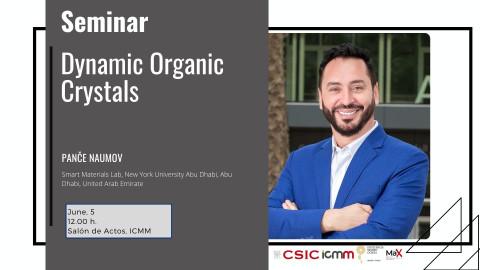
TITLE: Dynamic Organic Crystals
AUTHOR: Panče Naumov, Smart Materials Lab, New York University Abu Dhabi, Abu Dhabi, United Arab Emirates1
WHEN: June, 05 - 12PM
WHERE: Salón de Actos, ICMM. Madrid Institute of Material Sciences. C/Sor Juana Inés de la Cruz, 3. Madrid
ABSTRACT: The anticipated shift in focal point of interest of solid- state chemists, crystal engineers and crystallographers from structure to properties to function of organic solids parallels the need to apply our accumulated understanding of the intricacies of crystal structure to explaining the related properties, with the ultimate goal of harnessing that knowledge in applications that require soft, light-weight, and/or biocompatible organic solids. In these developments, the adaptive molecular single crystals [1-5] warrant a particular attention as a new class of materials for light, flexible, and environmentally benign devices, primarily memories, capacitors, sensors, and actuators. United under the umbrella term “crystal adaptronics”, the recent research efforts aim to realistically assess the appositeness of dynamic crystals for applications that require fast, reversible and continuous operation over prolonged periods of time. With the aim to highlight the most recent developments in the research of adaptive molecular crystals, this lecture will discuss their assets and pitfalls.
References:
[1] Mahmoud Halabi, J., Al-Handawi, M. B., Ceballos, R. & Naumov, P. (2023) J. Am. Chem. Soc. 145, 12173.
[2] Awad, W. M., et al. (2023) Chem. Soc. Rev. 52, 3098.
[3] Karothu, D. P., Mahmoud Halabi, J., Ahmed, E., Ferreira, R., Spackman, P. R., Spackman, M. A. & Naumov, P. (2022) Angew. Chem. Int. Ed. 61, e202113988.
[4] Spackman, P. R., Grosjean, A., Thomas, S. P., Karothu, D. P., Naumov, P. & Spackman, M. A. (2022) Angew. Chem. Int. Ed. 134, e202110716.
[5] Mahmoud Halabi, J., Ahmed, E., Sofela, S. & Naumov, P. (2021) Proc. Nat. Acad. Sci. USA 118, e2020604118.
BIO: Panče Naumov holds the position of full professor of chemistry with tenure at New York University Abu Dhabi (NYUAD). He also serves as a Global Network Professor of Chemistry at New York University's Faculty of Arts and Sciences and holds a cross-appointment at New York University's Molecular Design Institute. Additionally, he acts as the Director of the NYUAD Center for Smart Engineering Materials (CSEM), and leads the Smart Materials Lab (SML) at NYUAD. Naumov has been a fellow of the Radcliffe Institute at Harvard University. Naumov's Smart Materials Lab is widely recognized as the leading research team in chemistry and materials science in the UAE. According to Nature Index, the lab's output accounts for approximately 40-60% of both the number and fractional count of the high-impact publications in chemistry in the country each year.
Naumov obtained his PhD in chemistry and materials science from the Tokyo Institute of Technology in 2004, complemented by a BSc from Ss Cyril & Methodius University in Macedonia. Prior to joining NYU Abu Dhabi and NYU, he held research fellow positions at the Japanese National Institute for Materials Science (NIMS) and faculty roles at Osaka University and Kyoto University in Japan. With a research portfolio comprising over 320 publications, Naumov's group has secured over USD 15 million in extramural funds, along with substantial start-up and internal funding over the last two decades. He has delivered approximately 400 presentations at conferences and scientific gatherings, including over 100 invited talks at various institutions. Since 2012, he has mentored more than 60 students, overseeing PhD theses, undergraduate projects, and Capstone projects. Naumov is an active reviewer for around 100 international journals and over ten national and international funding agencies. Naumov holds the position of Associate Editor for the Journal of the American Chemical Society (JACS), overseeing solid-state chemistry, photochemistry, crystallography, and crystal engineering. He also serves or served as a member of the editorial or advisory boards for several reputable journals, such as Angewandte Chemie, Chemistry - A European Journal, Chemistry - an Asian Journal, Smart Molecules, SmartMat, FlexMat, Wearable Electronics, and ChemNanoMat. Furthermore, he has contributed as a guest editor for the Proceedings of the National Academy of Sciences of the USA.
Naumov is a member of the European Academy of Sciences. He holds the esteemed position of founder, secretary, and treasurer of the Industrial Liaisons of the UAE Chapter of the American Chemical Society (ACS). He also holds the prestigious title of founding President of the Emirates Crystallographic Society (ECS). Naumov is a councilor of the European Crystallographic Association (ECA), a consultant, and a member of the Commission on Structural Chemistry for the International Union of Crystallography (IUCr). Additionally, he is honored to serve as a member of the Natural Sciences Advisory Board and the Science in Media Committee of the Emirates Science Council. Naumov is recognized as a fellow of both the American Chemical Society (ACS) and the Royal Society of Chemistry (RSC). In recognition of his outstanding achievements, he received a graduate fellowship from the Japanese Ministry of Education and Science in 2000, the Human Frontier Science (HFSP) award in 2011, the Asian and Oceanian Photochemistry Association Prize in 2014, the Friedrich Wilhelm Bessel Research Award from the Alexander von Humboldt Foundation in 2015, the Radcliffe fellowship at Harvard University in 2018, the Hans and Marlies Zimmer International Scholar Program Award in 2020, and a special visa from the UAE Government for exceptional contributions to the country in 2020. He is currently a member of esteemed organizations including the American Chemical Society, The Royal Society of Chemistry (RSC), the European Academy of Sciences, the European Crystallographic Association (ECA), the American Crystallographic Association (ACA), the Mohamed Bin Rashid Academy of Scientists (MBRAS), which is the National Academy of Science of the UAE, and the Macedonian Academy of Sciences and Arts (MASA), among others.

