
Thomas Pucher is defending his thesis: "Becoming a scientist has never really been a dream of mine, it just happened along the way"
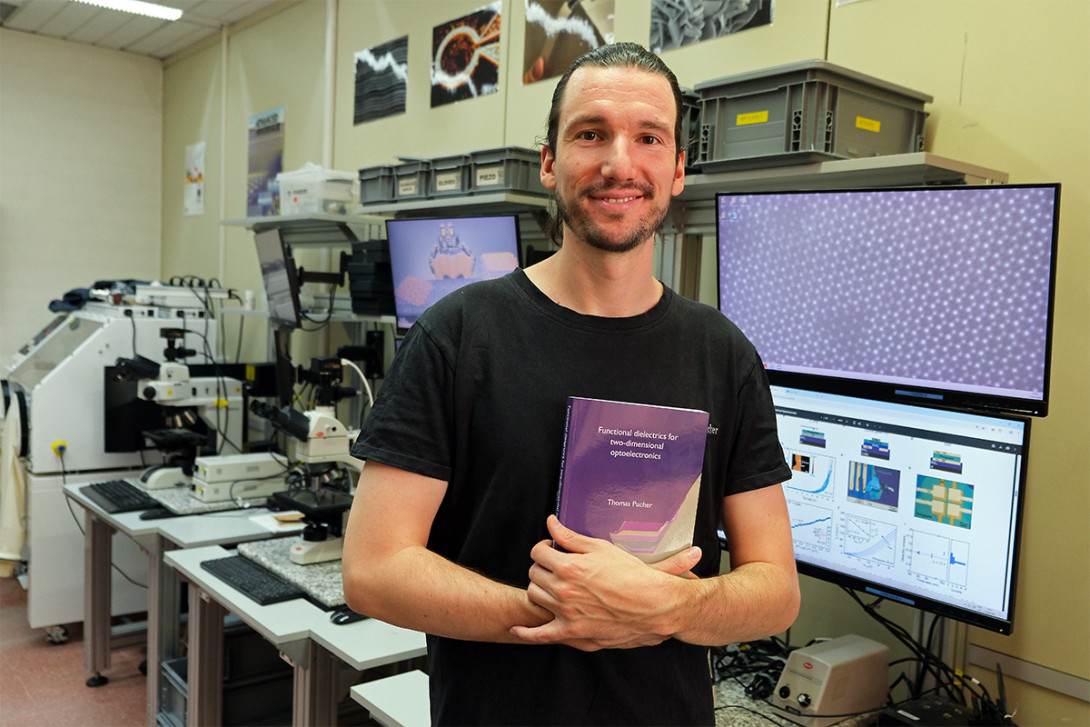
"I think I appreciate most the organizing skills that I have acquired through these years". The path of a thesis is a long one and goes beyond the research itself, as it reveals Thomas Pucher, PhD researcher at the ICMM. He will be defending his thesis next 12th June, whose title is 'Functional dielectrics for two-dimensional optoelectronics'. There, Pucher has explored various kinds of dielectric materials for two-dimensional semiconductors. Here, he explained us how he arrived to the ICMM from Austria, his country...
Who are your tutors?
I was so fortunate to be supervised by Andrés Castellanos and Carmen Munuera. My tutor at the university is Pablo Ares. Their guidance has made me the professional I am today.
Why did you choose ICMM for your PhD?
It was more of a "group choice" rather than an "institute choice". My former Master supervisor back in Vienna brought me in contact with Andrés while I was exploring PhD options and it felt like the right choice straight from the first zoom call.
How would you explain your research to a non-scientific audience?
The computer chips of tomorrow will likely be built from two-dimensional materials and wherever electricity flows through them, the right insulating materials will be critical to making them perform at their best. This thesis explores several types of these insulators and how they affect the performance of these chips.
What are the main applications of your research? Could you give us an example?
Two-dimensional materials have a vast range of applications. Here we use them for electronic components, such as transistors and logic circuits, but also for sensing applications as photodetectors, or even memory arrays for neuromorphic computing.
What are the lessons you had learnt here?
Apart from many many tools and scientific experience that I have gained, I think I appreciate most the organizing skills that I have acquired through these years. Handeling your own research projects, collaborations with other groups and also constantly adapting and improving the lab space for yourself and future members of the group has been a very rewarding experience and I am positive that it will help me handle my future career challenges.
Why did you become a scientist? Who have been your role models?
Becoming a scientist has never really been a dream of mine, it just happened along the way by following the subjects I was most curious about during my studies at university. By coincidence this got me in touch with smart people along the way that taught me how it is to be scientist and steered me towards a PhD.
Instituto de Ciencia de Materiales de Madrid (ICMM)
Sor Juana Ines de la Cruz, 3
Cantoblanco, 28049
Madrid, España
Telephone: (+34) 91 334 90 00
Email: @email
Communication Office: @email

Acknowledge the Severo Ochoa Centres of Excellence program through Grant CEX2024-001445-S/ financiado por MICIU/AEI / 10.13039/501100011033

Contacto | Accesibilidad | Aviso legal | Política de Cookies | Protección de datos