
Researchers create a formula to manufacture superluminescent diodes 10 times cheaper than conventional ones
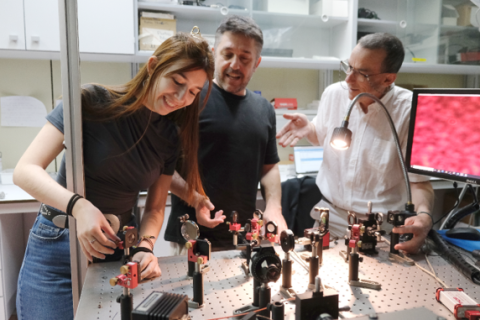
The Madrid Institute of Materials Science (ICMM-CSIC) has designed a novel formula that transforms a cheap commercial laser into a superluminescent diode, a much more expensive device that lies halfway between LED sources and lasers, with applications in medicine and Li-Fi technologies — which transmit information through light using a system equivalent to Wi-Fi. The method has been published in the journal JPhys Photonics.
"Lasers usually emit highly directional and coherent light, whereas LED lights have a more open beam, wider bandwidth, and do not generate interference," explains Antonio Consoli, lead author of the study, researcher at ICMM-CSIC and professor at Rey Juan Carlos University. "The superluminescent diode sits somewhere in between the two," he continues. Cefe López, also from ICMM-CSIC and the research leader, adds that these diodes normally require a specific cavity design during the manufacturing process to suppress laser action: "and that is where the additional cost lies," he explains.
Now, this team has followed a similar logic but added the concept of post-fabrication light scattering. In doing so, they have achieved a cost about ten times lower than that of conventional superluminescent diodes. "We bought a cheap commercial laser and modified its emission by damaging its physical structure through ablation to obtain our superluminescent diode," notes Andrea Martínez, also a researcher at ICMM-CSIC and part of the study.
The team explains that lasers are composed of a pair of internal mirrors that create the light beam through a feedback system: "Using pulsed laser ablation, we have broken the waveguide, suppressed that feedback, and obtained a high-quality light beam with the expected direction," Martínez continues.
Feedback suppression
"Ablation consists of bombarding the material with high-energy laser pulses, and in our process we optimized the energy of the light pulse, as well as the number of pulses used, also adjusting the beam diameter to match the width of the active region of the processed diode," Consoli continues. The result was a light beam with highly satisfactory characteristics: "We compared its emission characteristics in terms of output power, spectral width, spatial coherence, beam shape, and divergence angles," adds López.
The result has not only been the fabrication of the superluminescent diode but also the demonstration that scattering elements "can be used as a practical tool to eliminate feedback and suppress laser emission in optical cavities — a method that has rarely been reported to date," López celebrates.
For all these reasons, the team is convinced that this approach offers "clear advantages": "Our approach would contribute to the development of new techniques for manufacturing superluminescent laser diodes, due to its simple implementation and the unexplored potential of optical cavities with deliberately inserted defects," the researchers celebrate.
And not only that: "The added value of our method is that it can be applied after the manufacturing process of a commercial laser is complete, without needing to adopt specific standard fabrication techniques for the diode, which usually entail greater complexity and manufacturing cost," the team concludes.
Superluminescent diodes are still an emerging technology for applications in all kinds of sensors, from biomedical (such as optical tomography) to all types of optical devices, but their main benefit comes from the wireless transmission of information through light — so-called Li-Fi, which currently works by making lights flicker at speeds imperceptible to the human eye, achieving speeds far superior to those of traditional Wi-Fi.
Referencia:
Andrea Martínez Pacheco, Antonio Consoli* and Cefe López. Feedback suppression in 405 nm superluminescent diodes via engineered scattering. JPhys Photonics.. DOI: 10.1088/2515-7647/ae42a5
Instituto de Ciencia de Materiales de Madrid (ICMM)
Sor Juana Ines de la Cruz, 3
Cantoblanco, 28049
Madrid, España
Telephone: (+34) 91 334 90 00
Email: @email
Communication Office: @email

Acknowledge the Severo Ochoa Centres of Excellence program through Grant CEX2024-001445-S/ financiado por MICIU/AEI / 10.13039/501100011033

Contacto | Accesibilidad | Aviso legal | Política de Cookies | Protección de datos