
Gloria Platero takes up as Numerary Academic of the Royal Academy of Sciences of Spain: "Science is a collective endeavor"
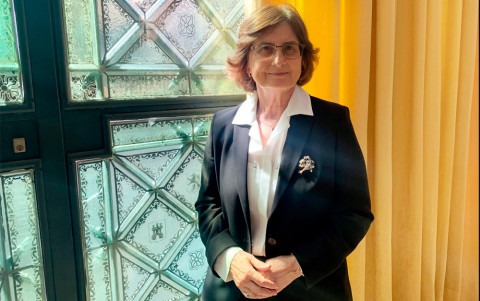
Gloria Platero, a research professor at the Madrid Institute of Materials Science (ICMM-CSIC), has been awarded her 64th medal by the Royal Academy of Exact, Physical and Natural Sciences of Spain. In a speech entitled The Role of Quantum Dots and Floquet Engineering in Quantum Technologies, the researcher offered a personal and professional overview of the main issues currently shaping quantum technologies.
Beginning her remarks with thanks to her father, mother, and grandmothers, the scientist from La Mancha remembered her school teachers and university professors for inspiring her enthusiasm for science from a young age. Platero also took a moment to acknowledge her colleagues, doctoral students, and other collaborators "for making me enjoy our daily work. It is a privilege for me to have a large family of friends around the world, a privilege that our work affords us," the researcher said.
"Science is a collective endeavor, built generation after generation through the effort and curiosity of those who seek to better understand the world around us," the scientist asserted during a speech that also served as a masterclass on quantum technologies. "For those of us who have had the privilege of dedicating our lives to scientific research, participating in this process is a profoundly stimulating and rewarding experience," the researcher acknowledged.
His speech provided a comprehensive overview of the state of the art in the quantum world. "One conclusion of this speech is the great potential of quantum dots as quantum simulators of a wide variety of physical systems, as well as a potential platform for quantum computing," explained Platero, who admitted that a "fundamental limitation" to this day is still scalability, "and it is in this endeavor that the scientific community's research in this field is focused."
Floquet Engineering
Listening to Platero has also meant acknowledging the importance of exploring the properties of matter in the presence of time-periodic fields, "since it allows us to understand how to modify its electronic, dynamic, or topological properties in a controlled manner and obtain information about those properties." "The central idea of Floquet's engineering is profound," Platero continued: "we don't modify the microscopic structure of the system; we modify its dynamics periodically to generate an effective Hamiltonian with new properties."
"The history of physics teaches us that great scientific advances usually arise when new experimental tools allow us to explore physical systems that were previously beyond our reach. In this sense, quantum technologies are now providing instruments that allow us to design and manipulate quantum systems with an unprecedented degree of control," the researcher explained.
At this point, Platero defended quantum simulators as elements that not only allow us to study fundamental phenomena with extraordinary precision, "but also offer us the possibility of designing new forms of matter based on the principles of quantum mechanics."
Moreover, the researcher has insisted that the experimental and theoretical study of the different platforms relevant to quantum technologies is what is allowing us to infer the advantages and difficulties of each of them: "It is this variety of platforms, and the comparison between them, that gives interdisciplinarity to quantum technologies and that allows us, through the design of artificial quantum systems, to directly explore the deep laws that govern matter."

Platero's speech concluded with a powerful message: "This joint effort promises, as often happens when research is conducted in a field addressed by different scientific communities, new advances in knowledge, both from a fundamental point of view and from the point of view of its applications in our society."
Platero's appointment as a full member of the Royal Academy of Physics (RAC) adds to a list of prestigious accolades the researcher has received in recent months. Since January 2025, the research professor has also been elected Vice President and Chair of Commission C8 of the International Union of Pure and Applied Physics (IUPAP).
In addition, Platero ended 2024 by receiving the Emmy Noether Award for her career in Physics. This prestigious prize, awarded by the European Physical Society (EPS) to women for their contributions to Physics, recognizes her "significant contributions to the theoretical understanding of Floquet systems (non-equilibrium systems) and their impact on the expansion of quantum materials." It also highlights her "excellent mentorship of young researchers and her tireless promotion of female talent in Physics." Platero is the third Spaniard to receive this important award, following Pilar López Sancho, also from the ICMM-CSIC (Spanish Institute of Molecular Physics - Spanish National Research Council).
Instituto de Ciencia de Materiales de Madrid (ICMM)
Sor Juana Ines de la Cruz, 3
Cantoblanco, 28049
Madrid, España
Telephone: (+34) 91 334 90 00
Email: @email
Communication Office: @email

Acknowledge the Severo Ochoa Centres of Excellence program through Grant CEX2024-001445-S/ financiado por MICIU/AEI / 10.13039/501100011033

Contacto | Accesibilidad | Aviso legal | Política de Cookies | Protección de datos