
ICMM-CSIC comes closer to achieving photovoltaic materials that adapt to European climate zones
Time passes and results are coming in. ADAPTATION, the Pathfinder project led by the Institute of Materials Science of Madrid (ICMM-CSIC) that will create devices capable of absorbing solar energy to convert it into electricity while also being able to cool themselves down, has now reached its halfway point, moving ever closer to achieving a photonic material whose optical response can be optimized according to the different European climate zones.**
A challenge whose success "will improve both electrical energy generation, thermal dissipation, and passive device cooling," explains Sara Núñez, a researcher at ICMM-CSIC and the European coordinator of the project.
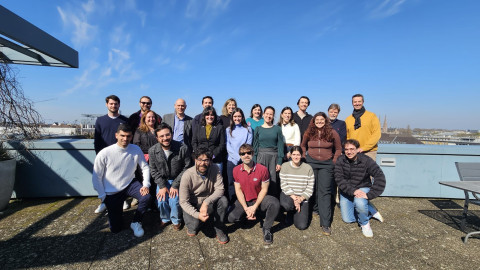
On the occasion of its annual meeting in Strasbourg to review achievements and remaining challenges, the scientist explains that in this second year, they have succeeded in preparing "an extensive library of the components that will form the base material for the devices developed in ADAPTATION."
This collection of materials will allow the working teams to fine-tune and optimize according to European climate zones. "With this solid foundation, we are now beginning the next phase of the project, which focuses on integrating and validating these materials into real devices," the researcher enthuses.
The ADAPTATION project, which has received €3.6 million through the European Union's Pathfinder grants, is developing a new approach to solar energy harvesting and thermal management. Inspired by nature and processes such as photosynthesis, the teams aim to combine both functions into a single, easily integrable material. Instead of relying on complex, multilayer structures, ADAPTATION proposes a streamlined solution that incorporates all functionalities into a single compound. "This enables a more scalable and adaptable technology, capable of adjusting to geographic diversity and future climate impacts," Núñez continues.
After its second year, the project now has a solid foundation that will allow it to work on the integration and validation of the devices. "The strong involvement of three high-level technology companies within the consortium ensures that the technology is designed from the outset with its practical application in mind," Núñez notes. The meeting in Madrid also served as a key moment to reinforce the project's strategy: integrating solar energy capture and thermal regulation into a single layer as an essential foundation for enabling future applications.
The entities participating in the project are, in addition to the Spanish National Research Council (with ICMM-CSIC and the Institute of Optics), the International Iberian Nanotechnology Laboratory (Portugal), the University of Vigo, the companies Avanzare Innovación Tecnológica SL and Cooling Photonics; the University of Strasbourg (France), Utrecht University (Netherlands), and the company Sunplugged – Solare Energiesysteme GMBH (Austria).
Instituto de Ciencia de Materiales de Madrid (ICMM)
Sor Juana Ines de la Cruz, 3
Cantoblanco, 28049
Madrid, España
Telephone: (+34) 91 334 90 00
Email: @email
Communication Office: @email

Acknowledge the Severo Ochoa Centres of Excellence program through Grant CEX2024-001445-S/ financiado por MICIU/AEI / 10.13039/501100011033

Contacto | Accesibilidad | Aviso legal | Política de Cookies | Protección de datos