
Álvaro Jiménez Galán receives 200,000 euros to consolidate his career in ultrafast physics
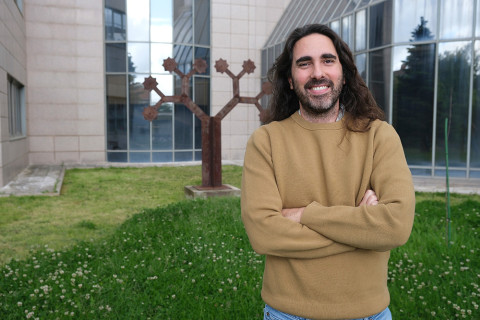
Álvaro Jiménez Galán, a Madrid-born researcher and Talent Attraction specialist at the Madrid Institute of Materials Science (ICMM-CSIC), has just been awarded a 2025 Research Consolidation grant, funded by the Ministry of Science, Innovation and Universities through the Agencia Estatal de Investigación (AEI). The grant provides €200,000 for a two-year project, during which the scientist will continue his research in ultrafast physics.
In his project, titled ‘LUMENS: Ultra-fast Manipulation of Electron-Hole Dynamics and Nonlinear Propagation in Solids with Light Pulses’, Jiménez will continue working along the lines of his research from recent years, during which, together with researcher Rui E. Silva, both have gained international recognition for his approach to ultrafast physics in materials.
Jiménez studies the ultrafast motion of electrons in crystalline and ultrathin (two-dimensional) materials, developing simulations and analytical calculations that enable control of electronic dynamics using structured light pulses.
Jiménez's project is structured in three complementary stages. His first step will be the study of so-called electron-hole correlations, which the researcher explains as follows: “What we want to describe is the electronic dynamics within the solid; until now, most studies in ultrafast and strong-field physics have only considered the independent movement of an electron within the bands of that material.”
His project aims to go further and introduce what is known as correlation: “how other particles influence the movement of that electron,” Jiménez explains. “By including these types of correlations and these types of forces between particles, other states are created that we want to observe and control in real time,” the scientist continues.
The second phase of his two-year project will focus on studying the propagation effects within the crystal; that is, observing the movement of electrons in crystals at the atomic level. Experiments used to measure electron movement employ lasers whose wavefront changes as it travels through the material. However, most theories describing these experiments do not account for these changes. “This approach makes sense in very thin, two-dimensional materials, but with other solids, you need to know how the laser changes as it travels through the material, since this directly impacts the electronic dynamics,” the researcher explains.
Therefore, he proposes “a much more realistic way of performing the calculations,” because “if you want to interpret an experimental signal that is macroscopic at a microscopic level, you have to take these effects into account; otherwise, the data you compare it to may include effects you don't control.”
The third step would be to compile all of the above to reach a key point: moving toward the ultrafast control of the electronic properties of various materials with spatially and temporally structured light. To do this, it is essential to simulate and understand light-guided electron motion within materials as accurately as possible.
Instituto de Ciencia de Materiales de Madrid (ICMM)
Sor Juana Ines de la Cruz, 3
Cantoblanco, 28049
Madrid, España
Telephone: (+34) 91 334 90 00
Email: @email
Communication Office: @email

Acknowledge the Severo Ochoa Centres of Excellence program through Grant CEX2024-001445-S/ financiado por MICIU/AEI / 10.13039/501100011033

Contacto | Accesibilidad | Aviso legal | Política de Cookies | Protección de datos