
Recovery in rats with spinal cord injury improves thanks to a new strategy that combines graphene foams with exercise
New breakthrough in the search for a cure for spinal cord injuries. A team from the Madrid Institute of Materials Science (ICMM-CSIC), together with the National Paraplegic Hospital of Toledo, has achieved greater recovery in rats with spinal cord injuries thanks to a combination of physical exercise and the use of graphene foams implanted in the injured area of the spinal cord.
The study, published in the journal Biomaterials and led by ICMM-CSIC researcher Conchi Serrano, proposes a new synergistic strategy that combines motor training—the only current tool that allows patients with paraplegia or tetraplegia to regain some functionality—with the use of three-dimensional foams made of reduced graphene oxide. These foams are inserted into the area where the spinal cord is injured and allow neuronal growth between the two severed sections. In fact, just a year ago, the same research team successfully reconnected the completely severed spinal cord of a rat using these materials developed in the laboratory.
This time, the team wanted to go a step further and studied the effect of these foams (called 'scaffolds') in rats with hemisection in the cervical region—the most commonly affected area in humans, where the spinal cord injury is incomplete and mostly affects only one of the mammal's forelimbs. They inserted these foams into the severed spinal cord area and, taking advantage of the neuronal growth that occurs, combined it with motor training, whose benefits are already widely known in spinal cord injury clinics and sports medicine.
The results are clear: absolutely all the anatomical features examined improve with the combined treatment. "Everything related to inflammatory markers in the injured area is better," Serrano says, adding that this reduction in inflammation is progressive, which is also positive.
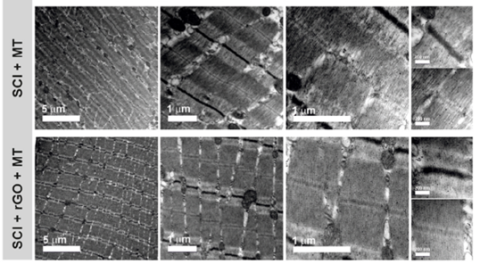
Furthermore, the research team has succeeded in increasing the number of blood vessels: “This means more blood reaches the injured area, which in turn facilitates tissue regeneration,” the researcher explains. The mechanical properties of the muscles (their firmness and flexibility) also improve. “This therapy mitigates the loss of oxidative fibers,” the scientist continues, adding that, upon analyzing the muscle structure, “we see that these fibers have a larger sarcomere size—the smallest anatomical and functional unit in muscle—and more mitochondria, indicating that they will be more efficient at producing energy and functioning.”
“At a more global and systemic level, we have seen that weight is regained more quickly with this synergistic therapy, and, analyzing specific organs such as the heart, we see that it also gains weight, with all weight alterations in the main organs generally being resolved more rapidly,” Serrano explains. The researcher also states that the next step will be to study the animal's behavior: “We need to see if the rats are functionally better, if the data we have obtained at the organ and tissue level translates into a functional improvement in behavior,” she indicates.
The researcher is convinced of the potential of this type of regenerative rehabilitation therapy, a new field of research that combines the best of traditional rehabilitation (exercise) with the results obtained from regenerative engineering therapies such as those developed with graphene foams. "This is the way forward," she says. However, she emphasizes that the research is still being conducted with small mammals, and that human trials are not even on the horizon. "We are working intensively, but we have to proceed step by step."
This work is part of the Piezo4Spine project, funded by the European Union through the Horizon Europe Pathfinder program, which aims to cure spinal cord injuries using nanotechnology, and the MICINN HyMaNaRé project. Nanomedicines are also being developed with the goal of finding cures for spinal cord injuries, and in the next phase of this work, these will be incorporated into the scaffold to further promote these promising regenerative findings.
Reference:
Esther Benayas, Raquel Madroñero-Mariscal, Yasmina Hernández-Martín, Jose A. Rodríguez-Alfaro, Javier Mazarío, Francisco M. Espinosa, Ricardo García, José L. Polo, Ankor González-Mayorga, Elisa López-Dolado, María C. Serrano. A regenerative rehabilitation strategy based on rGO scaffolds and treadmill training boosts neural, vascular and muscle repair features in chronic hemisected rats. Biomaterials. DOI: https://doi.org/10.1016/j.biomaterials.2026.124164
Instituto de Ciencia de Materiales de Madrid (ICMM)
Sor Juana Ines de la Cruz, 3
Cantoblanco, 28049
Madrid, España
Telephone: (+34) 91 334 90 00
Email: @email
Communication Office: @email

Acknowledge the Severo Ochoa Centres of Excellence program through Grant CEX2024-001445-S/ financiado por MICIU/AEI / 10.13039/501100011033

Contacto | Accesibilidad | Aviso legal | Política de Cookies | Protección de datos