
The ICMM organizes the Workshop on nanomaterials for sustainable energy production and storage: "Science Wins"
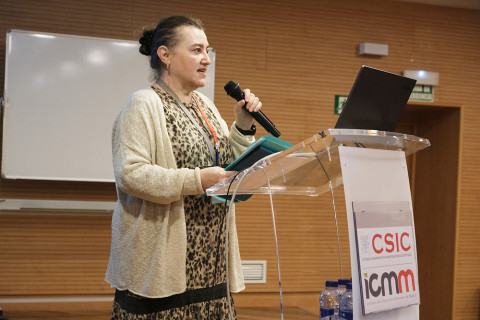
The Madrid Institute of Materials Science (ICMM-CSIC) held, on April 7, the workshop 'Nanomaterials for Sustainable Energy Production and Storage',, sponsored by the SustainableNano Network and funded by the center's own Severo Ochoa and Max-CSIC projects. Organized by Pilar Aranda, the center's deputy director; Pedro A. Serena, researcher; and María González, manager of the Severo Ochoa project, the meeting served as a reminder of the relevance of the work carried out and yet to be developed, with an emphasis on the importance of communicating it well. "Science Wins," concluded Serena, citing a phrase that can be read on the door of the Alcázar of Segovia.
The event, conceived as a gathering of leading researchers in the field of nanomaterials for sustainable energy uses, explored how these nanomaterials are transforming the energy landscape towards more sustainable models. Throughout the day, key advances were addressed in areas such as batteries and their recycling, safe supercapacitors, superconductivity, thermoelectricity, triboelectricity, photonic nanomaterials, photovoltaic technologies, CO₂ capture and storage, and hydrogen technologies.
"Let's understand energy better, let's do things for the future," was the optimistic and stirring conclusion of Pilar Aranda at the end of the day. She also wanted to highlight, this time at the beginning of the meeting, the difficulties the organization had in achieving parity among the participants: "This should make us reflect," she commented.
Science and Society
Pedro A. Serena, for his part, highlighted that in Spain "we are very good at generating knowledge, but it does not always leave academic centers. Our country is the second in Europe in terms of training doctoral students, but those people do not stay in the system," so he called for reflection on how to take advantage of all that effort and good work so that "today's science becomes tomorrow's technology."
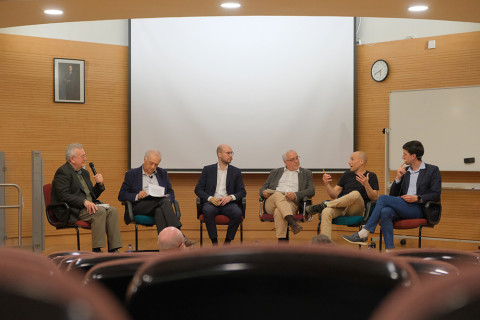
In the final round table, which included the participation of Enrique Palop (representative of the Ministry for the Ecological Transition and the Demographic Challenge (MITECO)), Enrique Sastre (institutional delegate of the CSIC in the Community of Madrid), Alejandro Marín Menéndez (Scientific Advisory Unit, CSIC), Xavier Obradors and Daniel Fernández-González (from the SNSSN network), the need for all of society, including the political class, to handle scientific evidence and have critical awareness was especially highlighted: "We need to adapt and change our way of communicating science to society so that it is accessible and generates critical thinking that allows decision-making," summarized Enrique Sastre.
"The connection between science and society is fundamental," agreed Alejandro Marín Menéndez. Enrique Palop, for his part, highlighted how science "is fundamental and completely necessary to improve society."
For a Green and Clean Transition
"The energy transition is closely related to materials. Nanotechnology is a catalyst for improving efficiency, reducing emissions, and developing new solutions," was another conclusion of the meeting, which also featured the participation of the director of ICMM, José Ángel Martín Gago. Another especially relevant conclusion was the ratification of the need to adopt an organized approach that integrates technology, economy, and sustainability to achieve a successful energy transition.
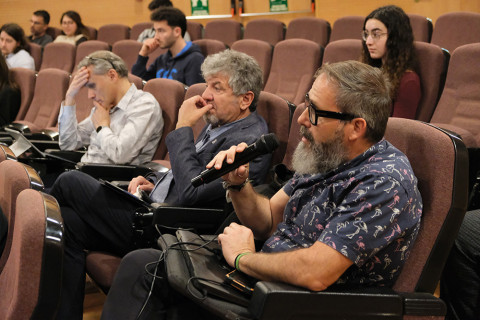
The first talk was given by CINN-CSIC researcher Daniel Fernández-González, who spoke introductorily about the relationship between nanotechnology and sustainability. Afterwards, ICMM-CSIC researcher Ainara Aguadero explained how solid-state batteries are a gateway to a "greener future."
Bernd Wicklein, also from ICMM-CSIC, explained his work on bio-based materials to achieve more efficient energy harvesting. Next, Xavier Obradors from ICMAB-CSIC reflected on how superconducting materials will impact the transition to clean energy.
"The future energy system will be hybrid, combining electricity and renewable fuels. It is a complex system," was another conclusion of the meeting, which also addressed topics such as two-dimensional materials and devices for energy management and storage, in a talk given by ICMM-CSIC researcher Miguel Muñoz. Ferry Prins from the Autonomous University of Madrid spoke about visualizing energy transport in nanostructured semiconductors, while Mónica Lira-Cantu from ICN2 discussed the current state and future perspectives of perovskite photovoltaic solar cells.
"Catalyzing Change: The Role of Multifunctional Materials in Solar Chemistry Technologies" was the talk given by IMDEA Energy researcher Víctor de la Peña. After him, Miguel Peña from ICP-CSIC spoke about the state of hydrogen research, "the final frontier." The final talk was given by ICMM-CSIC researcher Paco del Monte, who showed his work with metal-based electrolytes for energy storage obtained from used cathodes of lithium-ion batteries.
Instituto de Ciencia de Materiales de Madrid (ICMM)
Sor Juana Ines de la Cruz, 3
Cantoblanco, 28049
Madrid, España
Telephone: (+34) 91 334 90 00
Email: @email
Communication Office: @email

Acknowledge the Severo Ochoa Centres of Excellence program through Grant CEX2024-001445-S/ financiado por MICIU/AEI / 10.13039/501100011033

Contacto | Accesibilidad | Aviso legal | Política de Cookies | Protección de datos