
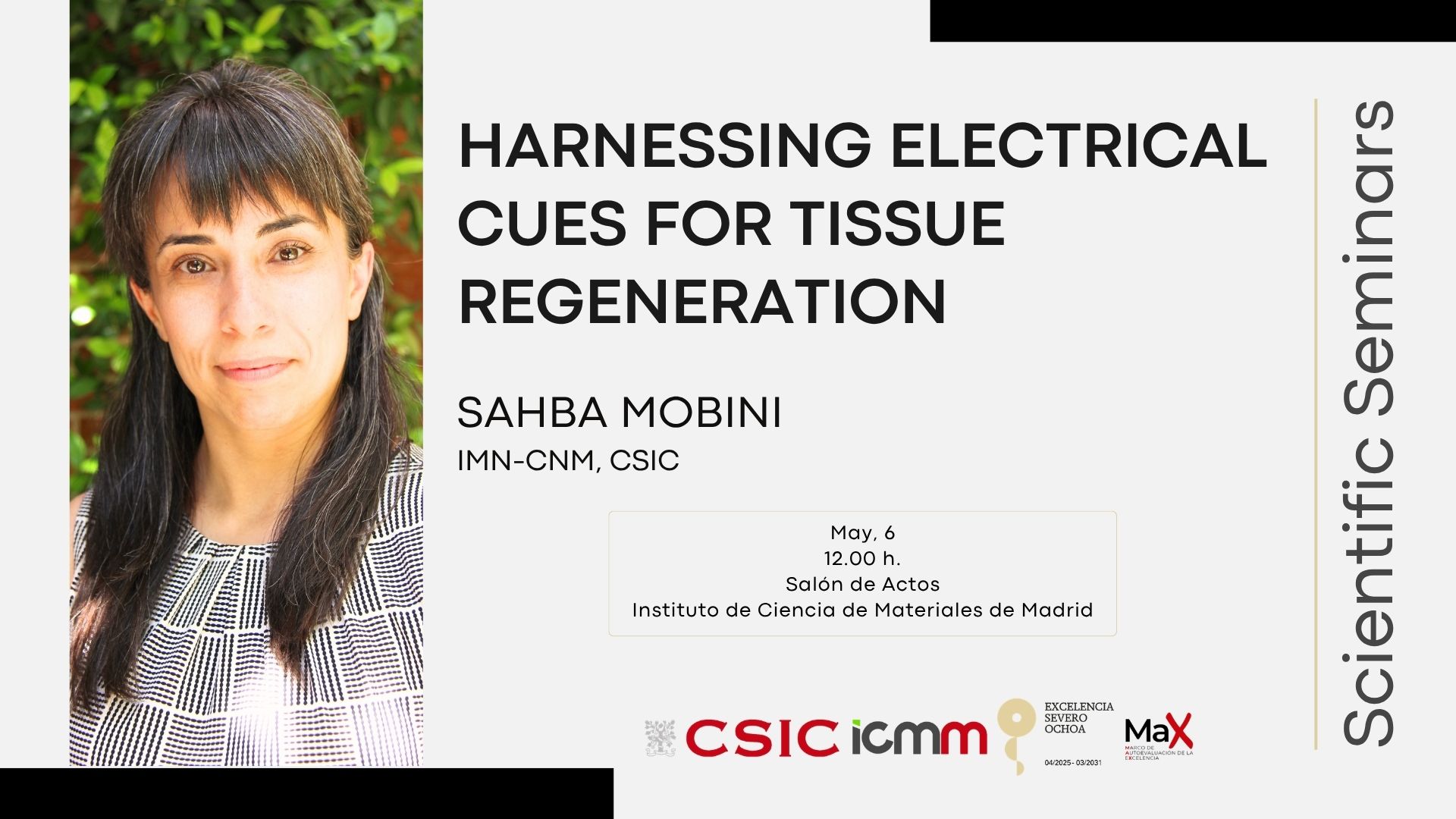
 TITLE: Harnessing Electrical Cues for Tissue Regeneration
AUTHOR: Sahba Mobini, ES4TERM Group Leader at Instituto de Micro y Nanotecnología, IMN-CNM, CSIC (CEI UAM+CSIC); Isaac Newton 8, 28760 Tres Cantos, Madrid, Spain
WHEN: May, 7 - 12PM
WHERE: Salón de Actos, ICMM. Madrid Institute of Material Sciences. C/Sor Juana Inés de la Cruz, 3. Madrid
ABSTRACT: The classical pillars of tissue engineering, cells, biomaterials, and biochemical signalling, are rapidly evolving, driven by novel cell sources, advanced materials, and innovative fabrication techniques. Alongside these, biophysical cues, including mechanical, architectural, and electrical signals, have emerged as critical regulators of cellular function and tissue development.1 Similar to mechanobiology, electrobiology is gaining prominence in tissue engineering and regenerative medicine. While traditionally the electrical properties of cells were studied mainly in electroactive cells, such as neurons, with a focus on action potentials, recent research has revealed that low-intensity electrical currents and plasma membrane potentials profoundly influence key cellular processes, including proliferation, migration, differentiation, and secretion.2,3
Exogenous electrical stimulation (ES) has therefore attracted growing interest as a versatile, non-chemical, and non-genetic tool for modulating cell behaviour and enhancing tissue regeneration.4 ES is applied using diverse protocols and methods to achieve therapeutic effects in both research and clinical contexts. However, critical questions remain regarding: 1) the underlying mechanisms of ES, 2) the most effective parameters for tissue regeneration, and 3) reproducibility across different systems.
Our laboratory has a long-standing history of developing ES devices.5–9 Recently, we have developed a framework for translating stimulation parameters across laboratory settings, combining deep electrochemical characterization, modelling, and the development of versatile ES devices.10
In early works, we demonstrated that mimicking or amplifying endogenous bioelectrical signals accelerates bone tissue remodelling both in vitro and in vivo. 6,11 At ES4TERM, our current research explores how low-voltage, low-frequency electrical stimulation supports neural maturation in healthy 2D neural cultures12 and 3D cerebral organoids,13 while also examining its potential to reduce apoptosis in pathological conditions, particularly stroke. We also investigate an indirect approach, termed “electrical cell priming,” in which controlled electrical stimulation of secretory cells, such as mesenchymal stem/stromal cells, enhances both the composition and potency of their extracellular vesicles (EV).14 This cell-free approach emphasizes the use of electrically enhanced EV rather than direct cell transplantation.
Overall, our work highlights ES as a powerful tool for modulating cellular function and supporting tissue regeneration in both electroactive and non-electroactive tissues. Future research at ES4TERM will focus on giving sense to the mechanisms of action and advancing the translational potential of ES-based therapies.
In this seminar, I will present our research line at ES4TERM lab, highlighting recent advances, key challenges, and strategies for integrating Electrical Stimulation into Tissue Engineering and Regenerative Medicine.
References
1. Zhao, S., Mehta, A. S. & Zhao, M. Biomedical applications of electrical stimulation. Cellular and Molecular Life Sciences 77, 2681–2699 (2020).
2. Thrivikraman, G., Boda, S. K. & Basu, B. Unraveling the mechanistic effects of electric field stimulation towards directing stem cell fate and function: A tissue engineering perspective. Biomaterials 150, 60–86 (2018).
3. Kadan-Jamal, K. et al. Electrical Stimulation of Cells: Drivers, Technology, and Effects. Chem. Rev. 125, 6874–6905 (2025).
4. Sanjuan-Alberte, P., Alexander, M. R., Hague, R. J. M. & Rawson, F. J. Electrochemically stimulating developments in bioelectronic medicine. Bioelectron. Med. 4, 1 (2018).
5. Mobini, S., Leppik, L. & Barker, J. H. J. H. Direct current electrical stimulation chamber for treating cells in vitro. Biotechniques 60, 95–98 (2016).
6. Mobini, S. et al. In vitro effect of direct current electrical stimulation on rat mesenchymal stem cells. PeerJ 5, e2821 (2017).
7. Mobini, S. & González Sagardoy, M. U. Nanostructured electrodes for the electrical stimulation of cells in culture, devices, systems and procedures associates, Granted Patent, ES2887832 B2. (2021).
8. Mobini, S. et al. Effects of nanostructuration on the electrochemical performance of metallic bioelectrodes. Nanoscale 14, 3179–3190 (2022).
9. Kulkarni, G., Garcia, J. M., Isasi Campillo, M., González, M. U. & Mobini, S. In Vitro Electrical Stimulation Devices: Practical Framework for Design, Fabrication, and Standardization. https://doi.org/10.2139/SSRN.5700702 (2025) doi:10.2139/SSRN.5700702.
10. Leppik, L. et al. Combining electrical stimulation and tissue engineering to treat large bone defects in a rat model. Sci. Rep. 8, 6307 (2018).
11. Diego-Santiago, M. del P. et al. Bioelectric stimulation outperforms brain derived neurotrophic factor in promoting neuronal maturation. Scientific Reports 2025 15:1 15, 1–16 (2025).
12. O’Hara-Wright, M., Mobini, S. & Gonzalez-Cordero, A. Bioelectric Potential in Next-Generation Organoids: Electrical Stimulation to Enhance 3D Structures of the Central Nervous System. Front. Cell Dev. Biol. 10, 901652 (2022).
13. Mobini, S. et al. Enhancing Brain Organoid Growth through Electrical Stimulation-Induced Amplification of Extracellular Vesicles. in 1st Mobility for Vesicles research in Europe (MOVE) Meeting (Malaga, Spain, 2023).

