
ICMM-CSIC researchers design a membrane that increases efficiency nearly tenfold in the hydrogen purification process
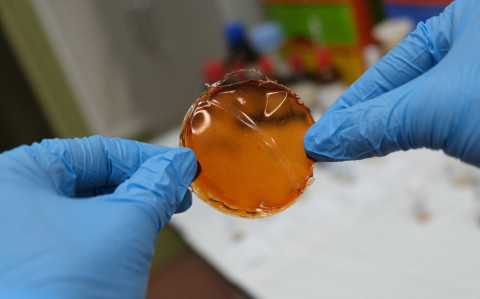
A study led by the Madrid Institute of Materials Science, part of the Spanish National Research Council (ICMM-CSIC), has designed and developed a new type of gas separation membrane that achieves performance nearly 10 times higher than other commercial membranes used for hydrogen purification. This development has been published in the Journal of Membrane Science, the leading journal in the membrane field.
Industrial demand for pure hydrogen is rising, as this element plays a key role in both the energy and environmental transitions. In this context, the most promising method for air purification and gas separation is based on membranes, since they “have low energy requirements, operational simplicity, and the ability to operate continuously,” explains Eva Maya, a researcher at ICMM-CSIC and the lead author of the study.
The research team, which also includes a large majority of female scientists, has improved commercial membranes based on polysulfone—a type of thermoplastic—by adding a porous component: “We take advantage of those pores, their voids, to discriminate between gas molecules, allowing the small ones to pass through,” the researcher continues.
“The membrane must withstand hydrogen pressure while also having a certain elastic component. Additionally, we need it to be capable of separating gases while allowing high permeability—that is, a high flow of the gas we are targeting, in this case, hydrogen,” explains the scientist. They have achieved all this in their laboratory: “We have increased hydrogen permeability by more than 800%, and also improved the membrane's selectivity by about 30%,” Maya celebrates.
Furthermore, the study stands out for the formula chosen to create the porous component added to the membrane, developed using a new synthesis technology called mechanochemistry, which consumes less energy and is much more sustainable. “We complete a synthesis in three hours that traditionally takes three days,” highlights Eva Maya.
Great potential for the petrochemical industry
Although the product's scalability is still pending, this new compound has great potential in the petrochemical industry, which is seeking new hydrogen purification methods to obtain more of this gas so key to the energy transition. “Our approach is very attractive for practical industrial applications because it reduces the synthesis time of porous fillers and mitigates the use of toxic solvents, which in turn minimizes hazardous waste,” concludes the researcher.
Referencia:
Sara Izquierdo, Nayara Méndez-Gil, Mohammad Afsar Uddin, Berta Gómez-Lor, Mar López-González, Eva M. Maya. Hexamethyltruxene-based hyper-crosslinked porous polymers as fillers in polysulfone membranes for H2 separation. Journal of Membrane Science. DOI: https://doi.org/10.1016/j.memsci.2026.125159
Instituto de Ciencia de Materiales de Madrid (ICMM)
Sor Juana Ines de la Cruz, 3
Cantoblanco, 28049
Madrid, España
Telephone: (+34) 91 334 90 00
Email: @email
Communication Office: @email

Acknowledge the Severo Ochoa Centres of Excellence program through Grant CEX2024-001445-S/ financiado por MICIU/AEI / 10.13039/501100011033

Contacto | Accesibilidad | Aviso legal | Política de Cookies | Protección de datos