
Juan Zurita is defending his thesis: "The persistence and independence gained here will be really helpful in my future career"
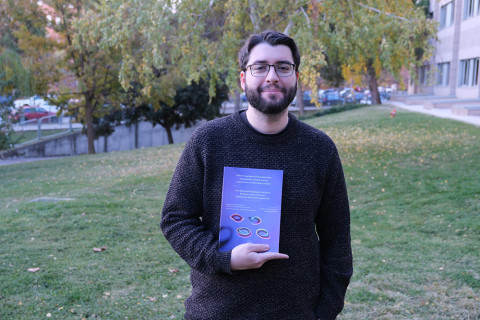
Juan Zurita has an important event next Friday, November 28: he will be defending his thesis at the Universidad Complutense de Madrid. After some years working alongside Gloria Platero, from the Madrid Institute of Materials Sciences (ICMM-CSIC), and Charles Creffield, from UCM, he is now ready to prove what type of researcher he is.
Why did you choose ICMM for your PhD?
When I was finishing my Master’s, I was offered the opportunity to do my research at CSIC, and I was glad to be able to work in such a vital institution for science in Spain. The people at ICMM were very welcoming and I’m grateful for having been part of it.
How would you explain your research to a non-scientific audience?
My work focuses on topological insulators, which are materials that are electrically insulating inside, but conduct electricity on their surface. This mismatch between the interior and exterior of a material is surprising to us physicists, and it was at first (decades ago) not well understood, given that the usual toolbox of solid state physics and quantum mechanics does not explain it. In order to understand what’s going on, we need to use topology, a branch of Mathematics that is not commonly used in Physics. It’s similar to geometry, but ignoring the notion of distance, so all topological properties stay the same under smooth deformation.
What are the lessons you have learnt here? Which one do you value the most?
I think I have learned a lot about how to do research, from the original idea to final publication, and that there will always be some percentage of ideas that will not make it to the end of the process. I have also learned how to communicate my work in conferences and workshops. I believe what I value most is the perseverance that I have acquired during these years.
How do you think this experience will contribute to your training and to your future?
I think it is an experience that I’ll never forget, and that the persistence and independence that I gained will be really helpful in my future career.
What are your plans once you finish your PhD?
I’m going to start a post-doc with Miguel Bello at IFIMAC, where I’ve already been working since September. My research will still be focused on topological materials, but with an emphasis on quantum optics and photonic implementations. I’m really excited to be able to continue in this line of research, but also learn new things at the same time.
Why did you become a scientist? Who have been your role models?
When I was a child, I was fascinated by space: all the planets, the probes we sent, black holes… When I was older I decided to study Physics because I thought it was a really beautiful science to learn, and it helps us understand the basic elements of the universe.
Of course, my family, my partner and my friends have been crucial for me during this time, and I couldn’t have done it without them. My scientific role models are not only people that have discovered amazing things (like Emmy Noether or Murray Gell-Mann), but also those who know how to explain them in an engaging way, like Martin Gardner or Isaac Asimov. They are also a hugely important part of why I chose this career pat.
Instituto de Ciencia de Materiales de Madrid (ICMM)
Sor Juana Ines de la Cruz, 3
Cantoblanco, 28049
Madrid, España
Telephone: (+34) 91 334 90 00
Email: @email
Communication Office: @email

Acknowledge the Severo Ochoa Centres of Excellence program through Grant CEX2024-001445-S/ financiado por MICIU/AEI / 10.13039/501100011033

Contacto | Accesibilidad | Aviso legal | Política de Cookies | Protección de datos