
ICMM-CSIC installs a new spectrophotometer capable of measuring quantum efficiency and half-lives
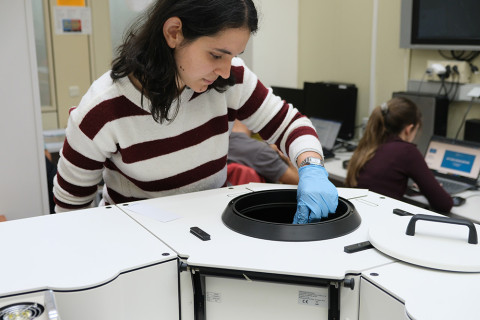
The Madrid Institute of Materials Science (ICMM-CSIC) enhances its optical spectroscopy capabilities with the installation of a new spectrophotometer capable of measuring the photoluminescence quantum efficiency of both solid and liquid samples, ranging from ultraviolet (250 nm) to near-infrared (1700 nm).
The equipment, with one of the most comprehensive configurations on the market, is unique in Madrid and among the few installed in Spain, explains ICMM-CSIC researcher Alicia de Andrés. The purchase was made possible thanks to the internal infrastructure call of the Institute of Materials Science of Madrid and co-funding from seven of the center's research groups.
This spectrophotometer is based on the FSL1000 model from Edinburgh Instruments, featuring a double monochromator for excitation and emission, which is optimal for very weak signals. It combines a wide spectral range (200-1700 nm) with various excitation sources (lamps and lasers), allowing not only for standard fluorimeter characterization but also for obtaining "up-conversion" spectra (emission at higher energy than the incident light), electroluminescence measurements, and half-life measurements ranging from 100 picoseconds to seconds using TCSPC (time-correlated single photon counting) and MCS (multi-channel scaling) techniques. Notably, it is possible to obtain reliable and reproducible values for internal quantum efficiency (IQY) and also for external quantum efficiency of electroluminescence (EQE), in the latter case using a known reference.
Measurements can be conducted across a wide temperature range for solid samples down to 5 K using a helium cryostat. Additionally, it has adapters to connect the sample chamber to a microscope via optical fibers, which will allow performing most of these measurements with submicrometric spatial resolution. Soon, it will be expanded with a system to control the temperature of liquid samples in the range of -30 to 80 °C.
For ICMM, this equipment is particularly relevant as the center designs and develops a wide variety of materials whose optical properties are crucial (photosensitive materials, optical sensors, phosphors, light-emitting LEDs, lasers, optical nanothermometers, etc.), thus requiring comprehensive optical characterization on versatile, user-friendly equipment that provides reliable results.
The researcher emphasizes that one of the fundamental aspects of this new apparatus is that it allows measurements both inside and outside an integrating sphere, and that optical fibers and cryostats can also be attached to it. All of this enables obtaining a wide variety of different measurements for different types of samples.
Instituto de Ciencia de Materiales de Madrid (ICMM)
Sor Juana Ines de la Cruz, 3
Cantoblanco, 28049
Madrid, España
Telephone: (+34) 91 334 90 00
Email: @email
Communication Office: @email

Acknowledge the Severo Ochoa Centres of Excellence program through Grant CEX2024-001445-S/ financiado por MICIU/AEI / 10.13039/501100011033

Contacto | Accesibilidad | Aviso legal | Política de Cookies | Protección de datos