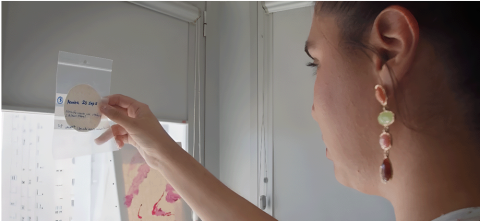
A high-strength technical paper that lasts longer and consumes fewer resources. This is one of the major challenges for sectors such as printed art, luxury publishing, decoration, and high-value packaging, and it has just been addressed in a new design created jointly by the Spanish National Research Council (CSIC) and the Universitat Politècnica de València (UPV). It is a new advanced technical paper that offers an ecological and efficient alternative to current premium papers.
"Our new high-strength paper performs in demanding mechanical printing processes such as rotogravure, stamping, or embossing," explains Pilar Aranda, a CSIC researcher at the Institute of Materials Science of Madrid (ICMM-CSIC) and one of the designers of this paper. Her paper has a grammage above 200 grams per cubic meter and withstands up to five tons of pressure without the need for pre-moistening – a process of adding more moisture to the paper – which gives these sheets a lower environmental impact by reducing work time and resource consumption.
Many current papers "have a limited lifespan" precisely because of this aforementioned moistening: "Furthermore, their high dependence on long fibers increases the cost of the product and hinders large-scale production," explains Rossi Aguilar, a researcher at the UPV's Center for Art and Environment Research (CIAE) who completed her doctoral thesis specifically on the development of this paper.
The new design is composed of recycled eucalyptus and linen fibers that are reinforced with natural additives, granting them "greater durability, printing fidelity, and sustainability," assert the scientists. This paper is compatible with water-based and oil-based inks and can incorporate conservation coatings, an innovation "useful in both artistic and industrial settings," adds María Eugenia Eugenio from the National Institute for Agricultural and Food Research and Technology (INIA-CSIC).
Art, Science, and Technology for the Environment
The researchers and their teams have not only designed this new paper but have also established the manufacturing method. This includes stages dedicated to preparing the additive, those related to mixing and homogenizing the cellulose and its additive, as well as filtering the resulting material and drying the finished paper, as noted by Margarita Darder (ICMM) and Raquel Sampedro (INIA).
The result is a technical paper with high strength and tensile properties that does not require moistening and has a long lifespan, making it ideal for products requiring prolonged conservation, such as illustrated books, catalogs, or luxury publications. "This material reduces operational costs by minimizing work duplication and material waste," adds Ana Tomás (UPV), who also explains that the paper has already been successfully tested in artistic applications.
The next step, they explain, involves "a collaboration to lead us to complete the development for the commercial exploitation of this invention." The researchers are fully convinced of their paper's potential in industries also related to luxury packaging (cosmetics, fashion, technology) or for studios focused on artistic and high-end printing.
For now, this invention has led to a new project combining theoretical, technical, and artistic research in favor of the environment: "Faced with the current precarious environmental situation, this outreach project proposes interventions and experiences through actions, exhibitions, workshops, conferences, lectures, performances, and patents of biomaterials," the researcher describes.
The project involves the participation of 76 artists, who will work conceptually and artistically with different materials on supports that vary according to their degree of contamination: "from synthetic plastic, persimmon skin, to papers and canvases affected by the DANA (Isolated High-Level Depression)," concludes Aguilar.