
Esther Benayas is defending her thesis: "When I started this journey, and still today, I believed that science could help improve people’s lives"
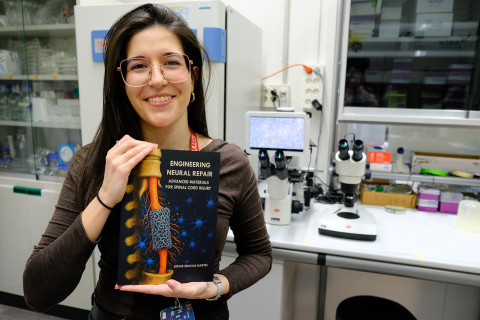
"Curiosity, and the chance of making a positive impact are what led me to become a scientist". This beautiful claim drived Esther Benayas to launch her career as a scientist. Now, she is reaching an important milestone in it. She is finally defending her thesis, which has been supervised by our researcher Conchi Serrano.
The thesis is entitled 'Engineering neural repair: advanced materials for spinal cord injury' and the defense will take place next January 30th at the ICMM-CSIC.
Why did you choose ICMM for your PhD?
What I really liked from the ICMM was the multidisciplinary and collaborative environment, which allowed me to learn from people with very different backgrounds and work together on common challenges.
How would you explain your research to a non-scientific audience?
My research focuses on designing advanced materiales to repair the spinal cord after an injury, with the ultimate goal of improving the quality of life of the people dealing with it. When the spinal cord is damaged, the communication between the brain and the body is interrupted, being the ability of the tissue to heal by itself very limited.
To address this problem, I develop small “bridges” that support the spinal cord’s healing process, by enabling neural cells and blood vessels to repopulate the lesion site, and helping to create an environment that favors regeneration and functional recovery.
What are the main applications of your research? Could you give us an example?
The main application of my research is the repair of the spinal cord after injury. By developing advanced biomaterials, the goal is to support the regeneration of damaged tissue.
For example, one of the materials I explored during my PhD is reduced graphene oxide, which act as a physical support at the lesion site and also promotes the growth of neural cells and blood vessels, reduced the infiltration of pro-inflammatory cells.
What are the lessons you had learnt here? Which one do you value the most?
During my PhD I’ve learnt that science is not only about experiments, long days in the lab, results or publications, but also about patience, persistence, and critical thinking. Research, and specially when biologically focused projects, rarely goes as planned, and learning how to adapt is a part of the process.
I would also highlight collaboration as a key and necessary component of the journey. Working in a multidisciplinary environment has showed me how much stronger and meaningful science becomes when different perspectives comes together.
How do you think this experience will contribute to your training and to your future?
This experience has given me strong scientific and technical training, but also skills that go far beyond the lab. I believe it has helped me grow both profesionally and personally, and has prepared me to face complex challenges in the future, wether inside or outsied academia.
What are your plans once you finish your PhD?
At the moment, I’m still exploring my next steps, but I’m interested in career paths that connect research with real-world impact, such as innovation, technology transfer, or science-related projects outside the traditional academic track.
Why did you become a scientist? Who have been your role models?
When I started this journey, and still today, I believed that science could help improve people’s lives. Curiosity and the chance of making a positive impact are what led me to become a scientist.
My role models are my parents. They are not scientists, but they have taught me that with hard work and perseverancem antything can be achieved. Those values have guided me throughout this journey and continue to shape the way I approach challenges.
Instituto de Ciencia de Materiales de Madrid (ICMM)
Sor Juana Ines de la Cruz, 3
Cantoblanco, 28049
Madrid, España
Telephone: (+34) 91 334 90 00
Email: @email
Communication Office: @email

Acknowledge the Severo Ochoa Centres of Excellence program through Grant CEX2024-001445-S/ financiado por MICIU/AEI / 10.13039/501100011033

Contacto | Accesibilidad | Aviso legal | Política de Cookies | Protección de datos