
Maxime Sauvan is defending his thesis: "Life would be boring if we knew everything"
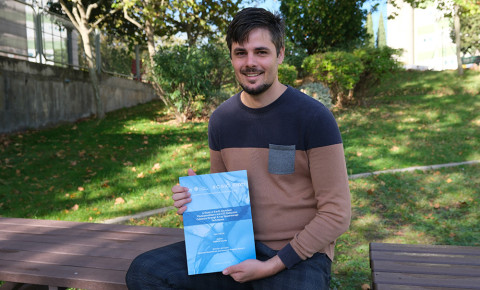
Maxime Sauvan came to the Madrid Institute of Materials Science (ICMM-CSIC) some years ago and now, after a simple blink, he is defending the work carried out at our facilities. Working hand in hand with Dooshaye Moonshiram, this young researcher will defend his thesis on November, 26, at the ICMM Main Hall under the title: 'A Study of Earth Abundant Photosensitizers and CO2 Reduction catalysts through X-ray Spectroscopy Techniques'.
Why did you choose ICMM for your PhD?
CSIC is a good place to do research as it gathers a lot of research groups in several fields of science. This is really interesting to learn and satisfy our curiosity about lots of things.
How would you explain your research to a non-scientific audience?
In order to give a better future, we need to develop sustainable energy to be less dependent of oil, gas, and coal to produce energy. Our research is based on the characterization of photosensitizers that are a component of natural photosynthesis playing the role of catching sunlight. Once they absorbed light, it can activate a catalyst to facilitate the chemical reaction of water splitting. By doing so, we can form oxygen or hydrogen or even methanol or other products in the case that we want to reduce the carbon dioxide via this process. Our characterization techniques help to find the properties of these photosensitizers.
What are the main applications of your research? Could you give us an example?
Dye sensitized photoelectrochemical cells (DSPEC), those cells absorb sunlight to split the water into oxygen at the anode (oxidation) and hydrogen to the cathode (reduction). It can also be used for the photoreduction of carbon dioxide at the cathode site.
What are the lessons you have learnt here? Which one do you value the most?
Well lessons whether in life or working abroad are quite a challenge, going through good and bad times, I would say the importance of having people around you makes everything easier.
How do you think this experience will contribute to your training and to your future?
The rich experience of living abroad will make me more confident for my next position and being less lost about all the administrative stuff, also with the difficulty of learning a new language.
What are your plans once you finish your PhD?
I need a break first, but I am already looking for post-doc positions.
Why did you become a scientist? Who have been your role models?
That just went along, I always liked science, and more particularly because there is always more to learn, life would be boring if we knew everything. I do not have a role model related to science; some people pass by my head, but they are more from my family.
Instituto de Ciencia de Materiales de Madrid (ICMM)
Sor Juana Ines de la Cruz, 3
Cantoblanco, 28049
Madrid, España
Telephone: (+34) 91 334 90 00
Email: @email
Communication Office: @email

Acknowledge the Severo Ochoa Centres of Excellence program through Grant CEX2024-001445-S/ financiado por MICIU/AEI / 10.13039/501100011033

Contacto | Accesibilidad | Aviso legal | Política de Cookies | Protección de datos