
Javier Pérez Carvajal wins an entrepreneurship grant from the CSIC's Converge program
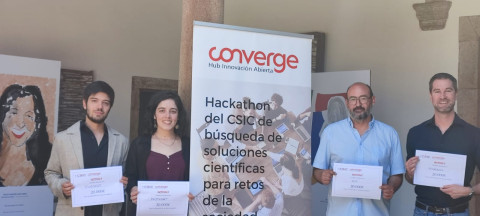
Javier Pérez Carvajal, a researcher at the Institute of Materials Science of Madrid, has designed a material that can recover critical metals and rare earth elements from water. Now, thanks to the ACTIVA-T entrepreneurship grant from the CSIC's Converge program, his project has been selected as one of those with the greatest innovative potential and awarded €20,000 to develop his business idea.
CSIC Activa-T is Converge's program that identifies projects with high innovative potential and supports them in their first steps toward the market. Through annual calls, projects based on knowledge generated at the CSIC have the opportunity to mature through a Hackathon that provides training to work on the commercial viability and business plan of their project. Following a Pitch Competition, they can be awarded up to €20,000, which is granted only to the four best projects submitted.
From now on, Pérez Carvajal's project will be able to advance thanks to the support of the ICMM-CSIC Technology Transfer Office, as well as additional internal and external expert staff and sectoral mentors. With this, the plan includes prototype creation, project valorization, and the creation or validation of its business model.
"With ACTIVA-T, we fund projects and offer training and accompaniment to catalyze and accelerate the transfer of scientific knowledge to the market," explain representatives from CSIC Innovación.
In this call, last Friday the ACTIVA-T Pitch Competition was held in Santiago de Compostela, following a hackathon held in Vigo and several weeks of intensive work. That day, the participating teams presented their projects before a specialized jury with the aim of demonstrating their market potential and competing for one of the grants of up to €20,000 offered by the program to support them on their path toward technology transfer.
In addition to Pérez Carvajal's project, titled 'MOF Flow Recovery: Technology based on floating MOF materials that enables the efficient and selective recovery of critical metals from electronic waste with low energy cost,' the other three selected ideas were 'PhotoHeart: Cardioprotective therapy based on photopharmacology that allows drugs to be activated with spatiotemporal precision to reduce myocardial damage after a heart attack,' produced by the Institute of Advanced Chemistry of Catalonia (IQAC-CSIC); 'ViVo NEXT: Artificial intelligence solution that predicts tumor growth in preclinical oncology, reducing study duration and the use of laboratory animals,' from the Institute of Synthetic Chemistry and Homogeneous Catalysis (CSIC-UNIZAR); and 'HydroBond: Advanced adhesive hydrogels for biomedical applications that combine tissue fixation and localized drug release,' from the Institute of Nanoscience and Materials of Aragon.
Instituto de Ciencia de Materiales de Madrid (ICMM)
Sor Juana Ines de la Cruz, 3
Cantoblanco, 28049
Madrid, España
Telephone: (+34) 91 334 90 00
Email: @email
Communication Office: @email

Acknowledge the Severo Ochoa Centres of Excellence program through Grant CEX2024-001445-S/ financiado por MICIU/AEI / 10.13039/501100011033

Contacto | Accesibilidad | Aviso legal | Política de Cookies | Protección de datos