
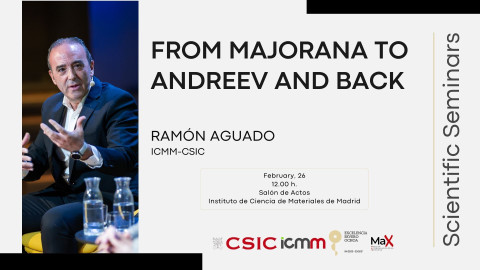
AUTHOR: Ramón Aguado. Quantum Materials for Quantum Technologies (Q4Q) group (ICMM).
WHEN: February, 26th - 12PM
WHERE: Salón de Actos, ICMM-CSIC
ABSTRACT: In the pursuit of a fault-tolerant quantum computer, topological qubits based on Majorana zero modes (MZMs) in hybrid semiconductor-superconductor devices offer a compelling pathway by encoding quantum information non-locally. However, over the past fifteen years, the experimental detection of MZMs has been hindered by controversy and debate, primarily due to the challenge of distinguishing them from trivial near-zero-energy Andreev bound states (ABSs). This "Majorana versus Andreev" dilemma [1] has prompted a paradigm shift: rather than being a hindrance, ABSs are now being harnessed as a foundation for novel qubit designs. One promising approach encodes a qubit in the spin state of a quasiparticle trapped in a quantum-dot ABS. By integrating such a superconducting spin qubit into a transmon circuit, one achieves intrinsic spin-supercurrent coupling. This enables a natural interface with circuit quantum electrodynamics, facilitating coherent control, high-fidelity readout, and strong qubit-qubit interactions [2,3].
A more direct route toward topological protection employs a modular construction analogous to assembling LEGO bricks to build a "minimal Kitaev chain." This nanostructure acts as a superconducting bridge, where ABSs coherently link two semiconductor quantum dots hosting MZMs at their endpoints. Crucially, these MZMs form a shared fermionic state whose occupation parity, even or odd, can be used to encode a non-local qubit. Recent experiments have leveraged quantum capacitance measurements on such platforms to achieve fast single-shot parity readout and demonstrate parity lifetimes exceeding one millisecond [4]. These results mark a critical milestone toward the realization of operational Majorana based qubits, as they establish the capability for initialization and real-time tracking of the encoded state in a qubit-style device geometry.
(1) From Andreev to Majorana bound states in hybrid superconductor-semiconductor nanowires,
Elsa Prada, Pablo San-Jose, Michiel WA de Moor, Attila Geresdi, Eduardo JH Lee, Jelena Klinovaja, Daniel Loss, Jesper Nygård, Ramón Aguado, Leo P Kouwenhoven, Nature Review Physics,2, 575–594 (2020).
(2) Spectroscopy of Spin-Split Andreev Levels in a Quantum Dot with Superconducting Leads,
Arno Bargerbos et al, Phys. Rev. Lett. 131, 097001 (2023)
(3) Direct manipulation of a superconducting spin qubit strongly coupled to a transmon qubit,
Marta Pita-Vidal, Arno Bargerbos, Rok Žitko, Lukas J Splitthoff, Lukas Grünhaupt, Jaap J Wesdorp, Yu Liu, Leo P Kouwenhoven, Ramón Aguado, Bernard van Heck, Angela Kou, Christian Kraglund Andersen Nature Physics, 19, 1110 (2023)
(4) Single-shot parity readout of a minimal Kitaev chain, Nick van Loo, Francesco Zatelli, Gorm O Steffensen, Bart Roovers, Guanzhong Wang, Thomas Van Caekenberghe, Alberto Bordin, David van Driel, Yining Zhang, Wietze D Huisman, Ghada Badawy, Erik PAM Bakkers, Grzegorz P Mazur, Ramón Aguado, Leo P Kouwenhoven, Nature 650, 334–339 (2026).

