
Researchers manage to see and understand chemical reactions in the ultrafast regime
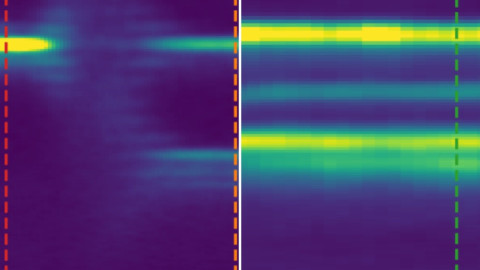
When a chemical reaction takes place, researchers normally know what they had at the beginning of the experiment and what they got at the end, but sometimes they don’t really know exactly what was happening in the middle of the experiment, which is key for understanding chemical reactions. Now, an international team led by the Madrid Institute of Materials Science (ICMM-CSIC) has been able to obtain detailed insights into a photo-induced reaction at specific atoms of a molecule with unprecedented speed.
Researchers employed the well‑established technique of x‑ray photoelectron spectroscopy (XPS), widely used across materials science. “This is a powerful method that provides direct, element‑specific insight into the local chemical environment surrounding a particular atom within a molecule or material,” explains Antonio Picón, the lead researcher at ICMM‑CSIC. However, until now, XPS has been limited to static measurements. By leveraging the novel capabilities of x‑ray free‑electron lasers (XFELs), researchers can now extend this technique into the time domain (known as time-resolved XPS or tr-XPS), while the reaction is occurring “Thanks to these new x‑ray sources, which generate extremely short flashes of light, we can even observe chemical bonds forming and breaking as they happen,” the researcher adds.
The study, recently published in Physical Review X, was carried out at the European XFEL facility in Hamburg. There, researchers worked with fluoromethane, a polyatomic molecule, that was excited by a near-infrared laser pulse lasting only a few femtoseconds, an incredibly short unit of time, equal to one quadrillionth (10⁻¹⁵) of a second, or a millionth of a billionth of a second.
While the light‑induced dynamics unfold, an x‑ray laser pulse, also only a few femtoseconds long, arrives at the molecule with a precisely (also femtosecond) controlled time delay. This timing control allows researchers to probe the chemical environment through XPS at the fluorine or carbon atom as the system evolves, effectively capturing the transient changes during the dynamics. “This study was one of the first time-resolved experiments showing that the Small Quantum Systems (SQS) instrument at the European XFEL is able to deliver detailed insights into transient dynamics during a chemical reaction,” notes Michael Meyer, lead scientist and group leader at the European XFEL.
“Thanks to this incredibly ultrafast scheme, we could measure the chemical reactions in real time,” adds Picón. “Our goal was not only to track the induced dynamics, but also to understand the time‑dependent shifts in the measured spectral lines,” the researcher continues. He explains that they managed to do this thanks to their theorical advances: “We show that the obtained high-resolution experimental results are described through an extension of the partial charges (PC) model, a very well-known theoretical model in static XPS experiments, to the ultrafast regime.”
Picón explains what this means: “The theory allows us to interpret the experimental data and avoid expensive calculations to calculate the spectral shifts.” Now, researchers are convinced that the application of the PC model “holds great promise for extending tr-XPS to investigate systems of higher complexity,” adds Dooshaye Moonshiram, also a researcher at the ICMM-CSIC and part of the study. “This way, we will use this with more practical applications, such as the design of catalytic molecules for energy applications”.
The researchers are already pursuing a follow‑up project. Antonio Picón is currently leading four XFEL initiatives involving experiments not only at the European XFEL, but also at SwissFEL and the Linac Coherent Light Source (LCLS). He explains that he is also collaborating with numerous international groups on additional experiments, serves on scientific panels for XFEL science, and is enthusiastic about the expanding opportunities these new x‑ray sources offer for studying matter in ways that were previously unattainable.
Reference:
Daniel E. Rivas, Lorenzo Paoloni, Rebecca Boll, Alberto De Fanis, Ana Martínez Gutiérrez,Tommaso Mazza, Solène Oberli, Oliver Alexander, André Al-Haddad, Thomas M. Baumann, Christoph Bostedt, Simon Dold, Gianluca Geloni, Markus Ilchen, Dooshaye Moonshiram, Daniel Rolles, Artem Rudenko, Philipp Schmidt, Svitozar Serkez, Sergey Usenko, Ángel Martín Pendás, Michael Meyer, Jesús González-Vázquez, Antonio Picón. Unraveling real-time chemical shifts in the ultrafast regime. Physical Review X. DOI: https://doi.org/10.1103/y6dt-1sfw
Instituto de Ciencia de Materiales de Madrid (ICMM)
Sor Juana Ines de la Cruz, 3
Cantoblanco, 28049
Madrid, España
Telephone: (+34) 91 334 90 00
Email: @email
Communication Office: @email

Acknowledge the Severo Ochoa Centres of Excellence program through Grant CEX2024-001445-S/ financiado por MICIU/AEI / 10.13039/501100011033

Contacto | Accesibilidad | Aviso legal | Política de Cookies | Protección de datos