
Researchers demonstrate the role of hydrogen in the formation of stellar dust in red giants
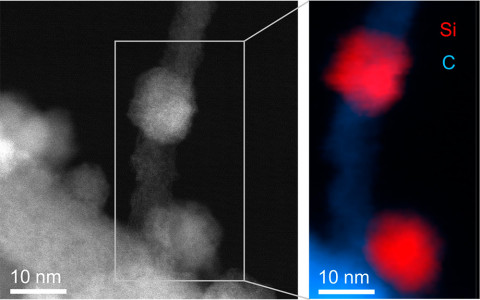
An international study led by the Spanish National Research Council (CSIC), an agency of the Ministry of Science, Innovation and Universities, has demonstrated the key role of hydrogen in the formation of cosmic dust from red giants, low- or intermediate-mass stars at the end of their lives. The work, which has significant astrophysical applications, has been published in the journal Nature Astronomy. The results were obtained using the STARDUSTmachine, a unique facility designed to produce cosmic dust analogs under controlled conditions.
“Cosmic dust is one of the fundamental ingredients of the universe,” explains José Ángel Martín-Gago, director of the Institute of Materials Science of Madrid (ICMM-CSIC) and one of the lead researchers of the study. Although it may seem like a minor component at first glance, “these tiny solid particles play a crucial role in the evolution of galaxies, in the formation of stars and planets, and in the chemistry of the interstellar medium,” adds Gonzalo Santoro, also a lead author of the paper and a researcher at the Institute of Structure of Matter (IEM-CSIC).
The researchers explain that, despite its relevance, “the atomistic mechanism at the nanoscale that leads to the formation of these grains remains, to a large extent, an open problem in astrophysics.” It is known where most of this cosmic dust originates: in the atmospheres of evolved stars, commonly known as red giants. “In these environments, dust grains form which, in the type of star we simulate in the laboratory, are composed mainly of amorphous carbon and silicon carbide,” adds Santoro.
Led by the Institute of Materials Science of Madrid (ICMM-CSIC) and the Institute of Structure of Matter (IEM-CSIC), the work involved the participation of several CSIC centers: the Institute of Nanoscience and Materials of Aragon, the Institute of Polymer Science and Technology, and the Institute of Fundamental Physics, as well as the French institutes IRAP-CNRS and the University of Toulouse.
Cosmic dust in a laboratory
To answer this enigma, this study has proposed an interesting approach that combines experimental astrochemistry, spectroscopy, electron microscopy, and theoretical modeling. Furthermore, and most interestingly, the experiments were conducted at the Institute of Materials Science in Madrid, using the STARDUST machine, a unique facility designed to reproduce the atmospheric conditions of red giants in the laboratory with unprecedented control.
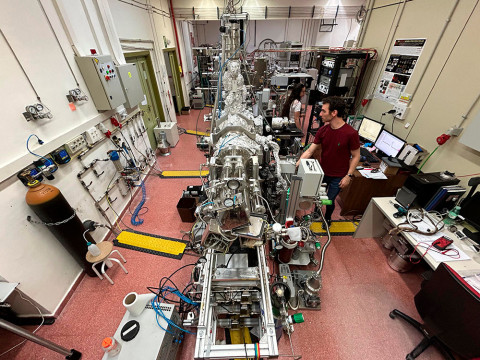
In this way, the study has succeeded in reproducing in the laboratory some of the chemical conditions present in the inner layers of the circumstellar envelopes of carbon-rich stars. “We have investigated the interaction between atomic carbon, atomic silicon, and molecular hydrogen, three of the most abundant species in these stars,” continues Martín-Gago. Using the STARDUST machine, the team generated nanoparticles analogous to those that form in the early stages of dust growth in space and, after analyzing them with electron microscopy and spectroscopy techniques, they were able to observe the formation of partially hydrogenated silicon carbide nanoparticles, along with amorphous carbon particles and even hydrogenated silicon.
The most significant result of this work is the demonstration of hydrogen's role as a "promoter of silicon carbide grain formation," Santoro continues. The study shows that when the density of molecular hydrogen is high, carbon and silicon interact much more than when hydrogen is absent, as it initiates a chain of chemical reactions.
The work also demonstrates that the silicon dicarbide (SiC2) molecule, observed in red giants, is the precursor molecule of cosmic silicon carbide dust, something that until now was only speculation, the researchers point out. José Ignacio Martínez, also from the Institute of Materials Science of Madrid and a participant in the study, explains that, in addition to the experiments, the theoretical modeling of the process was key to the study, allowing them to understand the role of hydrogen.
This result has important astrophysical implications, since previous astronomical observations had shown that these silicon dicarbide molecules decreased as the dust grains formed. Now, this study suggests an explanation: this molecule “is efficiently incorporated into the solid material.”
Beyond the clear astrophysical interest, the STARDUST team is especially proud: “The work illustrates how laboratory astrochemistry allows us to connect nanoscopic processes with large-scale cosmic phenomena,” says Martín-Gago. “The efficient combination of controlled experiments, advanced characterization techniques and theoretical modeling opens new avenues for understanding how dust grains form which, millions of years later, will eventually form planets, meteorites or even the matter that makes up our own solar system,” the researchers conclude.
Reference:
Guillermo Tajuelo-Castilla, Gonzalo Santoro*, Lidia Martínez, Pablo Merino, José Ignacio Martínez, Pedro L. de Andres, Gary J. Ellis, Álvaro Mayoral, Ramón J. Peláez, Isabel Tanarro, Marcelino Agúndez, Sandra Wiersma, Hassan Sabbah, José Cernicharo*, Christine Joblin* & José Ángel Martín-Gago*. The Important Role of Hydrogen in the Formation of Silicon Carbide in Evolved Stars. Nature Astronomy. DOI: https://doi.org/10.1038/s41550-026-02854-1
Instituto de Ciencia de Materiales de Madrid (ICMM)
Sor Juana Ines de la Cruz, 3
Cantoblanco, 28049
Madrid, España
Telephone: (+34) 91 334 90 00
Email: @email
Communication Office: @email

Acknowledge the Severo Ochoa Centres of Excellence program through Grant CEX2024-001445-S/ financiado por MICIU/AEI / 10.13039/501100011033

Contacto | Accesibilidad | Aviso legal | Política de Cookies | Protección de datos