THESE ARE SOME RECENT NEWS related with the ESISNA group research topics. For more information about us, visit: "Our group"

Congreso Fuerzas y Tunel 2012

Mayo 4th, 2012
Comments Off

El congreso de Microscopías de Fuerzas y de Efecto Túenl FyT2012 tendrá lugar en San Lorenzo de El Escorial los días 12, 13 y 14 de Septiembre.

Visita la página http://www.fyt2012.com

Registrate y manda tu abstract antes del 30 de Junio.

Congreso Fuerzas y Tunel 2012

Congreso Fuerzas y Tunel 2012

Nanotecnología para explicar el origen de la vida

Diciembre 20th, 2011
Comments Off

Entrevista a Jose Angel Martin Gago publicada en “El Mundo digital”. Por Mónica Luna.

Nanotecnología para explicar el origen de la vida

, ,

Ph.D. Grant offered

Noviembre 29th, 2011
Comments Off

Ph.D. GRANT

Financed by the Spanish Ministry of Science and Technology

Rolling grant MAT2011-26534 (Reactivity of Organic Molecules on Surfaces, REOMS)

Funding to develop research work in the ESISNA group (ICMM-CSIC) is offered for a person holding a physics/chemistry degree. The successful candidate is expected to work towards his/her PhD around the general subject of reactivity of organic molecules on surfaces, in particular the formation of fullerenes and graphene layers on metals and metal-oxides. The PhD will combine experimental and theoretical work, performing experiments in Ultra-High Vacuum with different Surface Science Techniques (e.g., Variable-Temperature Scanning Tunneling Microscopy), and using ab-initio Density Functional Theory to interpret the experiments.

Interested candidates should send a CV to

- Dr. Javier Mendez (jmendez@icmm.csic.es), and/or

- Dr. Pedro de Andres (pedro.deandres@csic.es).

stating their interests and previous formation. Reference letters will be appreciated.

Deadline: February 2012

Post-doc Scholarship of the I.U.S.V.T.A.

Noviembre 2nd, 2011
Comments Off

IUVSTA World Transfer Programme (WTC) rules:

General objectives:

To aid a recently qualified post doctoral scientist to transfer to another laboratory in another country in order to gain access to instruments (experiments, computers, large infrastructures) and/or to a special expertise, in order to progress more quickly her/his research project. The scientific stay will be of 3 to 12 months duration.
For a short stay, the grant consists of a travel grant but for a longer stay it may also cover some consumables or other discretionary expenses, upon the submission of a detailed budget plan.

Candidate eligibility:

Up to 3 years after the award of a PhD (or equivalent)

Financial support:

1) up to 1000 € for covering the cost of one return flight or train ticket (economy class only)

2) up to 2500€, according to the financial plan of the applicant for purchase of consumables, or small scientific equipment (excluding computers or accessories), conference fees and local costs, with a limit of / at a rate of max 250 € per month of stay

3) a special bonus of 500 €, paid to the scientist after acceptance - within 12 months of the stay - of a paper published in a recognized international peer reviewed scientific journal

More information:

I.U.S.V.T.A.  web site or gago@icmm.csic.es

STM videos of “dancing atoms”

Octubre 26th, 2011
Comments Off

Here you have the link to the Monica Luna’s blog in Nanotecnology appeared in “El Mundo”, with STM videos and comments by Javier Méndez.

“Bailando con átomos”

and the videos in other formats:

videos in youtube

, ,

Strain-Driven Moiré Superstructures of Epitaxial Graphene on Transition Metal Surfaces

Agosto 23rd, 2011
Comments Off

A simple model to explain graphene Moirés on single crystal metal surfaces

Graphene revealed to be the most outstanding material of the decade. Scanning Tunneling Microscope (STM) images have proved the existence of Moiré superstructures on epitaxial graphene due to the spatial coincidence of the atomic periodicity of the graphene lattice with that of the supporting metal. Formation of Moiré superstructures has been reported on many metals, e.g. Ru, Ir , Rh , Pt , and recently Cu , Pd , Co and Ni . Surprisingly, albeit the huge, recent and still increasing number of papers devoted to this topic, the most fundamental questions about the formation, structure and stability of these Moirés have not been deeply addressed and is still a matter of scientific dispute.

We have addressed this topic by combining a geometrical model with STM images of multidomain epitaxial graphene on Pt(111). Our model predicts the formation of 22 stable superstructures for Pt(111). We have experimentally found 19 of them, which are all predicted by the model. Moreover, by applying this method to published data we can reproduce the Moiré superstructures found for other single crystal metal surfaces and we foresee the existence of other periodicities, which have not been reported yet.

More information about this work

, ,

On-surface synthesis of cyclic organic molecules

Agosto 23rd, 2011
Comments Off

A tutorial  Chemical Society Review

On-surface synthesis can be regarded as an efficient means to build new molecular species by using bottom-up strategies. Recently, a collection of different reactions leading to large tailor-made organic molecules on single-crystal metal surfaces has been reported. The fundamental mechanisms controlling these reactions can be investigated from a surface science perspective. This discipline skilfully combines the use of characterization techniques at the nanoscale, with single-crystal metallic surfaces able to catalyse these reactions.

Full text in this link: J.Mendez, M. F. Lopez  and J. A. Martín-Gago; Chem. Soc. Rev., 2011, 40, 4578–4590

Schematic and simplified representation of an on-surface synthesis process. The deposited molecular precursors arrive to the surface and diffuse on it. In some cases, they could form an ordered SAM, which provides a pre-organization of the system. After a thermal treatment activated species can be formed. These species could lead either to surface organic frameworks (SOF) or being individually transformed into other different molecular species (nano-object), after for example, a surface assisted cyclodehydrogenation (SACDH) reaction.

, ,

The Welch Scholarship of the I.U.S.V.T.A.

Abril 4th, 2011
Comments Off

Scholarship Application Deadline Extended to April 30th 2011

The Welch Scholarship provides $15000 support once per year to a promising scholar who wishes to study vacuum science, techniques or their application in any field, and wants to spend a year in a research lab in another country.

This is an excellent opportunity to help offset some costs that may not be covered by other sources of funding, and this year the application deadline has been extended to April 30th. If you know promising candidates or are looking to host such a researcher, please refer to the detailed description and application forms and process on the IUVSTA web site at: http://www.iuvsta.org/iuvsta2/index.php?id=654

Please post of forward this to your colleagues, as appropriate. For any further questions, please contact the frank_shepherd@avs.org

Surfaces: Magic wands for molecular transformations

Febrero 24th, 2011
Comments Off

New bottom-up strategies for molecular assembly to tailor-build new molecules

The appearance on the technological scene of new electronic devices based on organic molecules is awaited with much expectation since they promise to be inexpensive, flexible, faster and smaller than those based on silicon technology. However, molecular electronics faces important challenges before the jump from the research laboratory to the technological centre can be made. To make this jump one of the new trends in the field aims to assemble organic molecules at specific locations on nanostructured surfaces, where they can subsequently be used as building-blocks for fabricating the active or passive electronic elements of a circuit. Rather than using the current top-down techniques, successfully applied in solid-state electronics, it seems clear that the groundwork for building molecular devices should start with a bottom-up strategy, presently lacking in the molecular engineer’s toolkit…

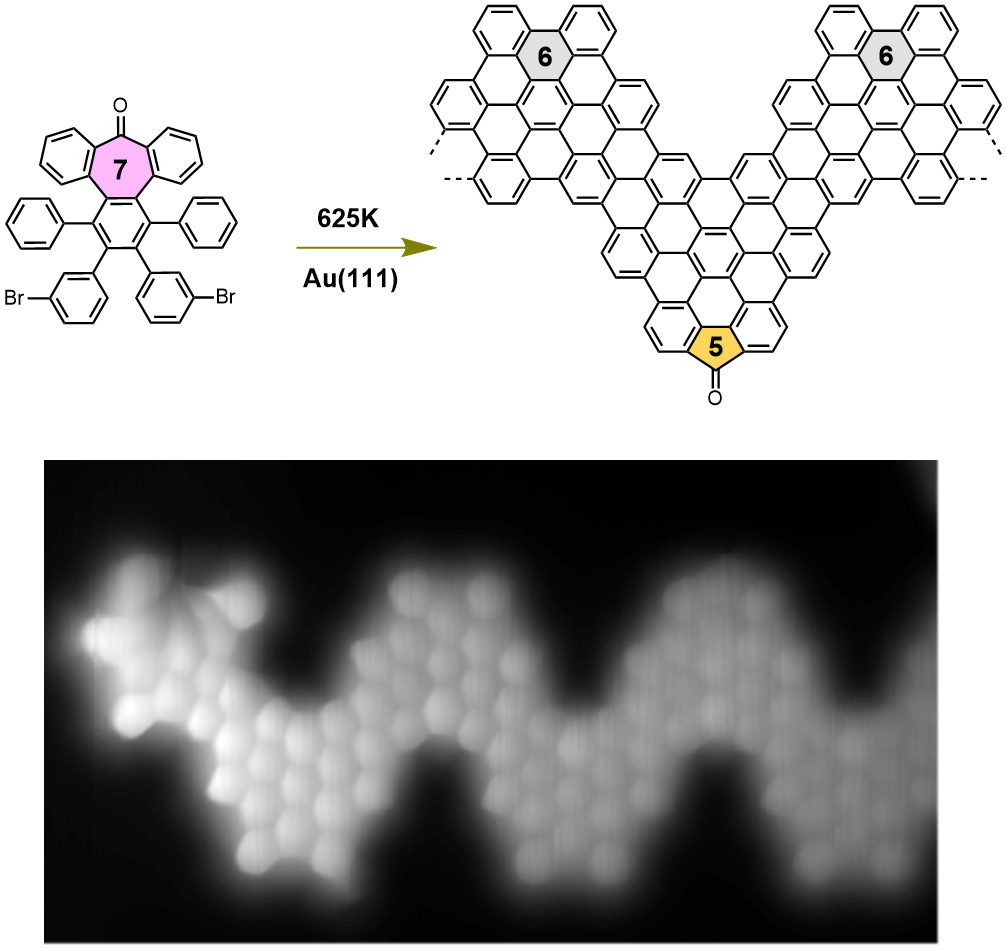
Roman Fasel and co-workers  have shown that is possible to synthesize nanographene, a highly strategic molecule, from less complex polyphenyls, demonstrating the capabilities of this new strategy for bottom-up fabrication, which can be easily extended to the assembly of nanographenes of varying dimensions

Read our complete opinion article in nature chemistry 3,11,2011

, , ,

An atomistic view of the the enantiomeric recognition of PAHs on single crystal metal surfaces

Enero 3rd, 2011
Comments Off

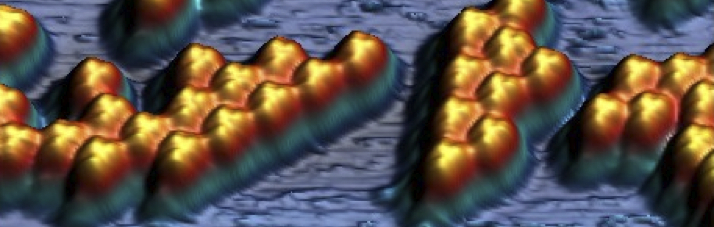
Recently published in Chemistry, a European Journal. Vacuum deposition of a planarized PAH, as C60H30 , on a single-crystal surface, as Pt(111), leads to surface induced chirality caused by the different landing side of the molecule, as depicted by in-situ STM images.

We show that the surface discriminate the landing side of an individual molecule. Molecules adsorbed “right” or “left”-hand present different structural geometries, shifted by about 35º between them. Large-scale DFT calculations explain the atomistic mechanism behind the enantiomeric recognition process.

, ,

Ordered Vacancy Network Induced by the Growth of Epitaxial Graphene on Pt(111)

Noviembre 30th, 2010
Comments Off

Published in Phys. Rev. Lett. by ESISNA

Graphene is one of the most outstanding materials of the decade. Among all the different proposed applications and protocols to growth it, epitaxial graphene on single-crystal metal surfaces have acquired a significant relevance as a model system where to rationalize their atomic structure, interaction with the support and excellent electronic properties. However, there are still many fundamental incertitudes about their interaction with the supporting substrate.

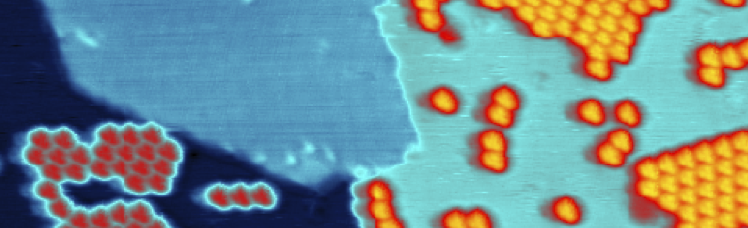
sub-monolayer coverage epitaxial graphene

sub-monolayer coverage epitaxial graphene

Here we present a full atomic determination of a new graphene phase with low crystallographic ratio with the substrate. The Pt substrate “adjusts” the position of their surface atoms to accommodate the graphene layer.

more information in this link

, ,

How are the STM images influenced by structural changes in the tip?

Noviembre 24th, 2010
Comments Off

What you see it is not what it is! Chemical and morphological changes in the tip are frequent during an experimental STM session. We have shown the effect of different tip apexes on the appearance of atomic features of STM images by relating experimental STM images with DFT calculations. The work, which focuses on the particular case of the TiO2(110)-(1×1) surface, also identifies typical point-defects of this surface, as oxygen vacancies and hydroxyl groups.

TiO2(110)-(1×1) surface seen with a “contaminated” tip

The left panel shows an experimental STM image of the TiO2(110)-(1×1) surface. As we show by DFT calculations, in this case the W tip is terminated in a single O atom adsorbed replacing the W-apex. The right panel shows a) the STM experimental image of the same surface. A double tip formed by two O atoms adsorbed at the apex is the responsible of the image, as inferred from the theoretical calculations (image b). The presence of defects has also been simulated theoretically (images c and d).

These results have been published on “Nanotechnology”.

More information

, ,

2D metal-organic layer covers gold substrate

Octubre 30th, 2010
Comments Off

Molecular networks provide new surface functionality and could enable the formation of more complex structures

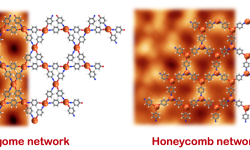
Nanoporous molecular systems have become an interesting field. They are well reported as templates for positioning nano-objects and for having remarkable applications in catalysis. Now metal-organic monolayers can be grown in a controlled way using PTCDA molecules and iron, which form stable coordination-based structures over extended areas.

Further information can be found in the journal Nanotechnology.

or an extended summary here

, ,

Fullerene on Google Homepage

Septiembre 4th, 2010
Comments Off

Twenty-five years ago today, on September 4, 1985, the buckyball was discovered at Rice University, and Google is commemorating that scientific discovery with an interactive doodle logo on its homepage


El sábado 4 de Septiembre, Google ha colocado en su página de inicio un nuevo logotipo -mejor conocido como “doodle”-, el cual es una representación animada de la buckyball, fullereno o buckminsterfullereno, el cual hoy se encuentra celebrando el 25º aniversario del su descubrimiento.

CURSOS DE VERANO EN EL ESCORIAL DE LA U. COMPLUTENSE

Mayo 28th, 2010
Comments Off

Nanociencia y su impacto social

DEL 19 AL 23 DE JULIO


Se celebró el curso Nanociencia y su impacto social.  Participaron los siguientes ponentes:

Nazario Martín León; Mª Ángeles Herranz Astudillo;Eugenio Coronado Miralles; Jean M. Lehn;  José López Carrascosa; José Ángel Martín Gago;  José Manuel Pingarrón Carrazón; Fernando Briones; José Manuel Pingarrrón Carrazón; Nazario Martín León; Mª Eugenia Anta;  Eiichi Nakamura;   Nicolás Agrait de la Puente y Rodolfo Miranda Soriano

consulta el programa completo en su pag. web

fiesta ESISNA-2010

Mayo 28th, 2010
Comments Off

Como ya viene siendo habitual, cada año, antes del verano, nos reunimos los integrantes del grupo junto con nuestros colegas del CAB y antiguos miembros en el campo para hacer una barbacoa a la hora de comer y luego, por la tarde,  una fiesta en la que están invitados todos los amigos y colegas. ¡¡ Hay cerveza y sangría para todos!!. Este es el programa previsto.

Este año será el día 11 de JUNIO-VIERNES.

Aqui puedes ver como llegar

Estas fotos corresponden a momentos estelares del año pasado

Interplay between fast diffusion and molecular interaction in the formation of self-assembled nano-structures of S-Cysteine on Au(111)

Marzo 23rd, 2010
Comments Off

Fast diffusing cysteine molecules on the Au surface can be regarded as a 2D molecular gas. Molecular “evaporation” and “condensation” from the gas on the surface morphological features takes place continuously. This process leads progressively to the formation of a number of stable arrangements, not previously reported, like single-molecular rows, trimmers and 2D islands. The long-range order process of the single amino-acid on gold surface is driven by the formation of stable electrostatic interactions between adjacent molecules.

This work is the result of a collaboration between the Centro de Astrobiología and ESiSNA group. These results have been published in Langmuir.

More information

, ,

el Azul de Prusia y el origen de la vida

Diciembre 19th, 2009
Comments Off

A partir de esta sal se pudieron originar sustancias esenciales para la vida. Foto: Nagem R.

Un equipo de investigadores del Centro de Astrobiología (INTA-CSIC) ha comprobado que a partir de la sal Azul de Prusia se pueden obtener cianuro de hidrógeno, urea y otras sustancias consideradas esenciales en la formación de las primeras moléculas biológicas. Para realizar el estudio, publicado en la revista Chemistry & Biodiversity, los científicos han recreado las condiciones químicas de la Tierra primitiva.

link a la noticia oríginal.

More information about the work.

,

Single-molecule wires out of single-molecule magnets

Octubre 22nd, 2009
Comments Off

A single molecular magnet (SMM) is a large molecule exhibiting superparamagnetic properties, and therefore it behaves like a magnet. One of the challenges attracting more attention over the last few years has been the development of new techniques that allow their nanostructuration and addressing on surfaces,  to promote their potential use for high-density information storage devices and quantum computing applications.

In a collaboration with the ICMAB  and CIN2 research institutes we have been able to shown that these

Mn12: single-molecule magnet

Mn12: single-molecule magnet

molecules self-assemble on a Au surface from liquid environment forming single molecular wires.  These results have been published in the journal:  Langmuir.

For more details about the relevance of the work: click here

, ,

Alhambra in ACSIN-10

Octubre 21st, 2009
Comments Off

Most of the people of the ESISNA group have attended to the international conference: “Atomic controlled surfaces and interfaces- ACSIN” held in Granada (September-2009).

The conference was mainly devoted to discuss about epitaxial graphene layers and organic molecules on surfaces.After the long scientific sessions we found also time for visiting the “Alhambra by night”, together with some friends.

Here you can see a photo gallery

Fiesta ESISNA

Junio 9th, 2009
Comments Off

Cada año, antes del verano, nos reunimos los integrantes del grupo junto con nuestros colegas del CAB en el campo para hacer una barbacoa a la hora de comer y luego, por la tarde,  una fiesta en la que están invitados todos los amigos y colegas. ¡¡ Hay cerveza y sangría para todos!!. Este es el programa previsto.

Este año será el día 10 de Julio.

Aqui puedes ver como llegar

TiO2: How to prepare a good surface.

Junio 9th, 2009
Comments Off

Surface Science studies use to prepare flat and clean surfaces by combining cycles of sputtering and annealing under Ultra-High Vacuum conditions. This procedure leads to large and ordered atomic terraces, as the shown in the image.

However, there are other simple methods to have single-atom  separated terraces. These could be an starting point previous to the introduction of the sample in an UHV system.  Here follows one of those.

,

How do you prepare your STM tip?

Mayo 6th, 2009
Comments Off

The STM technique presents a clear drawback: the uncontrolled shape and chemical termination of the tip.  This is particularly important in UHV, where atomic resolution is wanted.  Tip preparation methods are therefore essential for obtaining good STM images. Here follows our optimized recipe. If you find it useful, please, let us know. Also we would appreciate if you send us yours. We will publish them here.

, ,

Press releases on our Nature paper:

Febrero 20th, 2009
Comments Off

The paper entitled: Fullerenes from aromatic precursors by surface catalysed cyclodehydrogenation.
by G. Otero,et al.  Nature 454, 865-868 (2008) has been commented on different journals and magazines. Here you could find a list of some of the links.

, ,

Forthcoming conferences

Febrero 20th, 2009
Comments Off

Here follows a list of some forthcoming conferences related to our research topics:

STM imagen of a chain made of PTCDA molecules linked with iron atoms.

.

please, fell free to send us information about other non-listed conferences!

New DNA biosensor based on micro-cantilevers

Febrero 9th, 2009
Comments Off

The group leaded by  J. Tamayo y M. Calleja in “Instituto de Microelectrónica de Madrid-CSIC”, together with the ESISNA group and the “centro de Astrobiología”  have developped a  new nucleic acid biosensor based on the immobilization of self-assembled monolayers of DNA and PNA on micro-cantilevers.

These results have been published on “Nature Nanotechnology”

, ,

nota de prensa CSIC: El recortable más pequeño del mundo

Febrero 6th, 2009
Comments Off

Nota de prensa publicada por el CSIC en referencia al artículo publicado en NATURE.

The cyclation process

The cyclation process

,

Nuevo libro: nanociencia y nanotecnología.

Febrero 3rd, 2009
Comments Off

La FECYT (fundación Española para la ciencia y la Tecnología) ha publicado la obra titulada: “Nanociencia y nanotecnología: entre la ciencia ficción del presente y la tecnología del futuro”.

El grupo ESISNA ha colaborado con la mayor parte de las ilustraciones de microscopía de campo cercano de este libro.

,

NASA and Google Launch Virtual Exploration of Mars

Febrero 3rd, 2009
Comments Off

NASA and Google announced  the release
of a new Mars mode in Google Earth that brings to everyone’s desktop
a high-resolution, three-dimensional view of the Red Planet.

Mars planet

Mars planet

, ,

Origami at the nanoscale, or fullerenes “à la carte”.Nature Vol 454- 07193

Enero 27th, 2009
Comments Off

How to make fullerenes “a la carte”:  recently published in NATURE by ESISNA.

, ,

SIMULACIÓN DE AMBIENTES PLANETARIOS: Nuevo laboratorio en el Centro de Astrobiología

Enero 23rd, 2009
Comments Off

El centro de Astrobiología dispone de  una nueva unidad de simulación de ambientes planetarios e interestelares dedicada a reproducir en un laboratorio las condiciones de presión, atmosfera y temperatura de diferentes planetas.

Marte en la Tierra

Marte en la Tierra


, ,

ESTE ES EL BLOG ESISNA

Diciembre 1st, 2008
En esta sección pretendemos mostrar diferentes noticias que vayan pasando o resultandonos interesantes. Si quieres enviarnos alguna noticia interesante o comentar alguna, por favor, envianosla. GRACIAS.
This section is devoted to scientific news related with our research line.  If you would like to publish something here or comment  previous news:  please, send us the information and we will upload for you.
thank you!