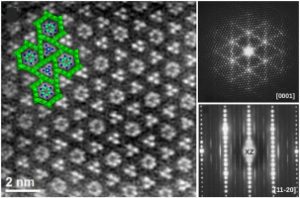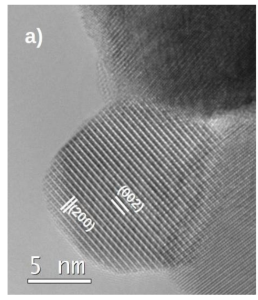
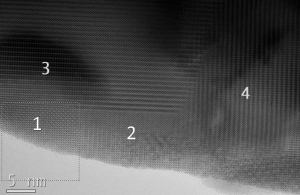
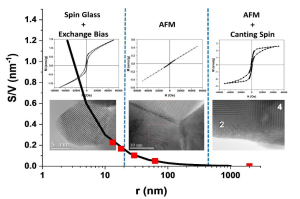
In this work, we have studied structural and magnetic properties of LaFeO3 as a function of the particle size d, from bulk (d >> 1 μm) to nanoscale (d ≈ 30 nm). A large number of twins were observed for large particles that disappear for small particle sizes. This could be related to the softening of the FeO6 distortion as particle size decreases. It was observed that the bulk sample showed spin canting that disappeared for d ~ 125 nm and can be associated with the smoothening of the orthorhombic distortion. On the other hand, for d < 60 nm, the surface/volume ratio became high and, despite the high crystallinity of the nanoparticle, a notable exchange effect bias appeared, originated by two magnetic interactions: spin glass and antiferromagnetism. This exchange bias interaction was originated by the formation of a “magnetic core–shell”: the broken bonds at the surface atoms give place to a spin glass behavior, whereas the inner atoms maintain the anti-ferromagnetic G-type order. The LaFeO3 bulk material was synthesized by the ceramic method, whereas the LaFeO3 nanoparticles were synthesized by the sol-gel method; the particle size was varied by annealing the samples at different temperatures. The physical properties of the materials have been investigated by XRD, HRTEM, TGA, and AC and DC magnetometry.
En este trabajo hemos estudiado las propiedades estructurales y magnéticas de LaFeO3 en función del tamaño de partícula d, desde un tamaño de partícula grande (d >> 1 μm) hasta nanoescala (d ≈ 30 nm). Se observó un gran número de maclas para partículas grandes que desaparecen para partículas pequeñas. Esto podría estar relacionado con el ablandamiento de la distorsión de los octaedros FeO6 a medida que disminuye el tamaño de las partículas. Se observó que la muestra másica mostró un “canting” de espín que desapareció para d ~ 125 nm y puede estar asociada con el suavizado de la distorsión ortorrómbica. Por otro lado, para d < 60 nm, la relación superficie/volumen se hizo elevada y, a pesar de la alta cristalinidad de la nanopartícula, apareció un notable “bias” por efecto de intercambio, originado por dos interacciones magnéticas: “spin glass” y antiferromagnetismo. Esta interacción de intercambio de “bias” se originó por la formación de un «core-shell” magnético: los enlaces rotos en los átomos de la superficie dan lugar a un comportamiento de vidrio de espín, mientras que los átomos internos mantienen el orden antiferromagnético de tipo G. El material másico de LaFeO3 se sintetizó mediante el método cerámico, mientras que las nanopartículas de LaFeO3 se sintetizaron mediante el método sol-gel; el tamaño de partícula se varió recociendo las muestras a diferentes temperaturas. Las propiedades físicas de los materiales se han investigado mediante XRD, HRTEM, TGA y magnetometría AC y DC.
D. Alshalawi, J. M. Alonso, A. R. Landa-Cánovas, and P. de la Presa, “Transition from AFM Spin Canting to Spin Glass–AFM Exchange as Particle Size Decreases in LaFeO3,” Nanomaterials 13, 1657 (2023)